'India's growth is in everyone's interest'
New Delhi, The Financial Express
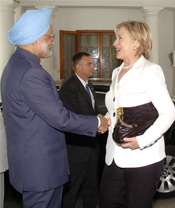
The US Secretary of State, Ms. Hillary Clinton meeting the Prime Minister, Dr. Manmohan Singh, in New Delhi
|
The US said it would not initiate any steps that impede India’s economic progress. While making a strong pitch for a low-carbon economy, US secretary of state Hillary Clinton said, “The US does not and will not do anything that will limit India’s economic progress. We believe that economic progress in India is in everyone’s interest and not just in the interest of Indians.”
She was speaking at a conference on climate change at the ITC green building in Gurgaon. Clinton also said India was well positioned to lead the fight against hunger through increasing agricultural yield and technology innovation.
While acknowledging the US’ responsibility as the biggest historic emitter of greenhouse gas, she said, “But we also believe that there is a way to eradicate poverty and develop sustainability that will lower significantly the carbon footprint of the energy that is produced and consumed to fuel that growth.”
Allaying India’s concern about negotiations on climate change, especially about the impact of binding cuts on greenhouse emissions on economies of developing countries, Clinton said addressing climate change and achieving economic growth are compatible and ‘both countries can devise a plan that will dramatically change the way we produce, consume and conserve energy.’ Minister of state for environment and forests Jairam Ramesh, who was also present in the conference, categorically said, India would not accept any “legally binding” reductions but assured that its carbon footprint would never exceed that of developed nations. He asserted that New Delhi was “simply not in a position” to accept any legally binding emission reductions and made it clear that India was not running away from responsibilities on the issue.
India contributes 4% of the world’s emissions from burning fossil fuels, compared with 20% from the US.
Ramesh, however, said, “Both sides have agreed on the need of partnership, concrete partnerships, on projects in various fields like energy efficiency, solar energy, biomass, energy-efficient buildings of the type that you are seeing here today.” We have made a good beginning. We have taken a small step today. We will continue our engagements in multilateral forums. But we will also have bilateral engagements,” he added.
Later in the day, during a visit to Indian Agricultural Research Institute (IARI) in New Delhi, the visiting envoy said India has a critical role in fighting global hunger through increasing agricultural yield and technological innovation.
“To lift people out of poverty and to give every child born in India a chance to live up to his or her given potential is a goal that we share with you,” Clinton said.
While stating that mainly due success of ‘green revolution’, despite having only 3% of total global agricultural land, India has been feeding its population, which is about 17% of the global population, Clinton said the country must invest more in ‘processing and value addition’ in agriculture sector. On the critical role of private sector in increasing agricultural yield and promotion of food processing, Clinton said, “We are going to explore partnership in agriculture & we can be helpful to India,” She also said that henceforth the official development assistance given to many countries including India for various feeding programme, would focused towards increasing agricultural yield so that hunger could be eliminated from the roots. “We will be announcing five pillars of our cooperation with India. One of the strongest will be agriculture,” she said. |
India's economic agenda:
PM's McKinsey Quarterly interview
The prime minister discusses his plans to modernize the country's infrastructure, attract foreign investment, and create jobs—all in the service of eliminating chronic poverty and disease in India.
Prime Minister Manmohan Singh of India would like to finish a job he started in 1991. Then, as finance minister in a new government, Singh orchestrated the economic reforms that brought India back from the brink of bankruptcy and set it on a course that made it one of the world's fastest-growing economies. Among the changes were devaluing the rupee, dismantling the infuriatingly bureaucratic business permit system called the license raj, and opening the tightly closed economy to foreign companies. The economic reforms he put in place have been backed by successive national governments and have brought a measure of prosperity and respect to India.
Singh became prime minister in May 2004, when the Congress Party won a surprise victory in national elections. But Congress's triumph was the result of a populist backlash against economic reforms that were seen as benefiting just a few of the 1.1 billion people of India, a large portion of whom remain impoverished, and the party holds power through a loose coalition. Against this backdrop, some questioned whether Singh, the country's first Sikh prime minister and an economist by training, could preserve the reform program, much less move it forward. Full Interview |
|
Five Indian banks among top 1,000 in the world
Five Indian lenders figure in the 2009 list of the world’s top 1,000 banks compiled by trade magazine ‘The Banker’ after a year of carnage in the global banking industry.
Only two, State Bank of India at the 64th position and ICICI Bank Ltd at 81st, figure among the top 100 by tier I capital—a core measure of a bank’s financial strength that consists largely of shareholders’ capital.
Punjab National Bank, HDFC Bank Ltd and Bank of India come in at 239, 242 and 263, respectively, on the list to be published in the July issue of ‘The Banker’, a part of the Financial Times group that has been carrying the rankings since 1970.
The publication of the latest list follows the financial maelstrom that ripped through the global banking industry last year, requiring governments in the US and Europe to rescue banks with hundreds of billions of dollars in state-funded bailouts.

Banking industry profits last year fell 85.3% from $780.8 billion in 2007 to $115 billion and return on equity dropped from 20% to 2.69%, according to the magazine.
JP Morgan Chase and Co., followed by Bank of America Corp., Citigroup Inc., Royal Bank of Scotland Plc. and HSBC Holdings Plc. were the top five banks by by capital strength. HSBC was the only one among the five that didn’t receive any government support.
Banks that stuck to the basics, taking deposits and lending in their home markets, fared the best. Industrial and Commercial Bank of China, followed by China Construction Bank and Spain’s Banco Santander SA achieved the largest profits.
“In future banks will be run much more conservatively,” said the magazine’s editor Brian Caplen in a press statement. “Regulators will require them to hold more capital and be less leveraged. This will reduce the profits of the industry as a whole but will bring about a safer banking system.” |
Ludhiana easiest city in india to start trade and industry
The study is an independent evaluation of the business environment in 17 cities in India by the Doing Business Unit of the World Bank Group. It indicates areas where states can initiate measures to reduce times, costs and procedures related to starting and operating business.
The Government of India is making concerted efforts on continuous basis to reform in business regulations in the country. It encourages State Governments to take regulatory reforms including replication of national and international best practices in States.
This information was given by Shri Jyotiraditya M Scindia, Minister of State for Commerce & Industry, in a written reply in the Rajya Sabha today. |
|


