 |
|
Overseas investors buy the India story again
MORE
[+] |
 |
|
Dehradun: Capital of beautiful valley
MORE [+] |
|
| |
|
| |
Safeguarding interests of farm sector in
WTO talks
New Delhi
|
|
The principal aim of India’s negotiating strategy in the agriculture negotiations has been to protect the interests of farmers particularly with regard to their food and livelihood security. Substantial and effective reductions in domestic support and customs tariffs by developed countries, while enabling developing countries to protect and promote the interests of their low income and resource poor farmers, is a key priority for India and other developing countries in the agriculture negotiations. The flexibilities available to developing countries including, inter-alia, lower tariff cuts than developed countries, self-designation of Special Products (SPs) which will have more flexible tariff reduction commitments than other products and the Special Safeguard Mechanism (SSM) to safeguard the interests of farmers in the event of surges in import volumes or a fall in prices would be utilized by India for protecting low income and resource poor farmers of the country.
Multilateral negotiations under the Doha Round have not yet resumed formally at the World Trade Organization. At major international meetings held in the recent past where the Doha Round was discussed, India expressed support for the early resumption of negotiations, as a fair and equitable, rule-based multilateral trade regime best serves the needs of developing countries.
This information was given by Shri Jyotiraditya M. Scindia, Minister of State for Commerce & Industry, in a written reply in the Rajya Sabha today. |
Japanese financial firms develop a yen for India
New Delhi, Source: The Hindu Business Line
|
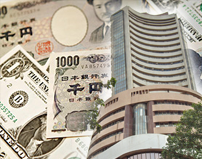
Just a fortnight ago, Japan’s financial powerhouse, Nomura, bought a 35 per cent stake in LIC Mutual Fund in a deal that values the Indian firm at Rs 800 crore. Nomura, which in October 2008 acquired the Asian operations of bankrupt US investment bank, Lehman Brothers, employs over 2,600 people in India. Last week, it surprised many by issuing half-page advertisements expressing its intent to recruit in large numbers. Four days ago, the mutual fund arm of the $120 billion Shinsei Bank launched its second equity fund in India, just a month after the first — an open-ended liquid fund — closed successfully. The second fund, which closes on August 25, will invest in companies that are leaders in their respective sectors, and the fund house plans to launch two more equity funds by the end of this financial year.
|
And the Indian outfit of Japan’s Daiwa Securities is set to launch investment banking operations, having just received the Securities and Exchange Board of India’s permission for category one merchant banker status. Daiwa Securities SMBC India, which already has an institutional and foreign institutional investor (FII) broking business, is also planning to enter private equity investments in India.
Why and why now?
Virtually no growth opportunities and returns in the Japanese market
India has more potential than China, since the Japanese are already present in that market in large numbers
In January 2008, 100 yen could fetching Indian assets worth Rs 35.27. Today 100 yen fetches Rs 50-plus
How are they coming?
As Sebi-registered FIIs
Offshore funds raising money from the Japanese markets for India-specific investments
Buying/setting up companies in India — mutual funds, investment banks, broking firms
Most of the big brands and industries in Japan are looking at India opportunities
What is the investment potential?
$20 billion in the next four or five years.
Though the number of Japanese foreign institutional investors in India is still negligible, it’s significant that 8 of the 11 registered with Sebi entered in the past year and a half. The country head of a large Japanese investment bank in India said the trickle was set to turn into a flood, with many Japanese FIIs in various stages of registration with the market regulator.
Investment bankers said India could easily see $20 billion worth of Japanese money in the next three years. The manufacturing sector has been receiving Japanese foreign direct investment for some time now; the entry of that country’s financial services sector is a relatively recent phenomenon. A big chunk of Japanese funds has so far been coming into India by way of offshore funds, with many Indian houses such as SBI Capital, UTI and DSP Blackrock raising money from the Japanese markets to invest in India. But Japanese companies said it’s time now for direct investment.
Why this change?
Aditya Rattan, President, Daiwa Securities SMBC India, has an answer. Apart from a stable government and the booming infrastructure sector, Rattan sees the stronger yen as a compelling reason for the Japanese to look at India with renewed interest. For example, in January 2008, Japanese investors were able to get Indian rupee assets worth Rs 35.27 for 100 yen. For the same amount of yen, they will now get assets worth Rs 51. They can, in fact, get even more, since Indian asset valuations have fallen over the period. Sanjay Sachdev, country manager for India, Shinsei banking group, said India was still significantly behind China in Japanese investments, but things could change since the country was now being increasingly seen as a viable investment destination.
Also, while Japanese investors have huge cash, they want to now invest in countries like India, since there are virtually no returns in their own country and their favourite investment destination — the US — is losing sheen, with the dollar weakening. Sensing the opportunity, a 45-member Assocham and commerce ministry delegation is now busy in road shows in Tokyo, Osaka and Yokohama to woo Japanese investors. Siddharth Shah, head of funds practice at Nishith Desai Associates, said, “There had been an increased interest in Indian paper from Japanese investors and for many of them, Singapore is a good entry point into the Indian markets in view of the favourable tax treaty between India and Singapore as part of the Comprehensive Economic Co-operation Agreement. Further, Singapore and Japan also have a tax treaty, making Singapore a hub for Japanese investors investing in Asia.” |
Good growth by cement industry
New Delhi
|
|
The capacity of cement industry at the end of 2008-09 was 219.17 million tonnes (large plants). The industry witnessed a growth of 7.9% during the year 2008-09.
Cement dispatches (including exports) for the 11 months April, 2008 to February, 2009 was 163.05 million tonnes. The dispatches during the corresponding period of the previous year was 151.26 million tonnes. The first quarter of the financial year 2009-10 witnessed a growth of 12.4% with a production of 50.15 million tonnes. With the thrust being given by the Government for the development of infrastructure, housing and rural connectivity, the cement industry is likely to witness a growth of around 9% during the year 2009-10.
This information was given by Shri Jyotiraditya M Scindia, Minister of State for Commerce & Industry, in a written reply in the Rajya Sabha today. |
|
Exports from India had increased 3.4% in dollar terms and 17% in rupee terms during 2008-09.
Significantly, trade deficit-the difference between exports and imports-with China expanded 41% in the period under consideration and stood at Rs 92, 676 crore (nearly $20.3 billion), pointing towards fast expanding imports from China. This is nearly one fifth (18%) of India's trade deficit during the period under consideration, the highest for any of its trade partners.
According to data available with the commerce ministry, imports from China expanded 28% and stood at Rs 1,27,938 crore ($ 28.10 billion) in April to February period of 2008-09. In fact, increase in large number of chemical and metal items import from China has been of concern for India, which has initiated many anti-dumping and safeguard duty mechanism investigations to ascertain if Chinese companies are adopting any unfair trade practice. Historically, the US has been India's top trading partner. Exports to the US have mostly been greater than imports, as a result of which India has enjoyed a trade surplus. However, hit by the economic recession, demand for goods in the US plummeted, impacting exports from India as well. |
Limitless plan among SEZs approved
The Board of Approval (BoA) for Special Economic Zones granted two formal approvals and one in-principle nod for setting up of IT/ITeS and Multi Service SEZs in West Bengal, Andhra Pradesh and Tamil Nadu.
The formal approvals included a IT/ITeS SEZ in West Bengal by Shyam Steel Industries and Genome Balley Biotech SEZ in Andhra Pradesh by Andhra Pradesh Industrial Infrastructure Corporation Tower. A multi-service SEZ in Tamil Nadu, promoted by Limitless Properties, was given an in-principle nod.
Formal approvals
Addressing the BoA members, the Commerce Secretary and Chairman of BoA, Mr Rahul Khullar, said so far 576 formal approvals have been granted for setting up of SEZs out of which 319 have been notified.
He further said that over Rs 1,08,903 crore have been invested in SEZs during the short span of time and direct employment of the order of 3,87,439 have been generated.
Total exports from the SEZs for the year 2008-09 stood at Rs 99,689 crore registering a growth of about 50 per cent over the previous year.
Meanwhile, an official said the BoA has also extended the validity period for the approval given to Satyam Computer Services Ltd’s three special economic zones by a year.
The validity of the approval given to Satyam’s proposal to set up two information technology SEZs in Hyderabad and another in Visakhapatnam was to end this month. However, the domestic BPO is expected to ride on huge size and net margins are anticipated to increase to about 12.5 per cent by 2012 from about 9 per cent in 2008,” states the report. Seth adds the Indian buyer is very different from his global counterpart. “When it comes to pricing, it will be the buyer who will decide. Players will have to devise different models and cost structure in the emerging markets,” he added. |
Indian per capita income rises by US$ 86.78 in 2008-09
Per capita income of Indian individuals stood at US$ 773.54 in 2008-09, according to Central Statistical Organisation data. This information was shared by the Minister of State for Finance, Mr Namo Narain Meena, in the Rajya Sabha, the Upper House of the Parliament on July 28, 2009.Per capita income is an individual’s earnings share from the yearly income—generated in the country through productive activities—and divided amongst all citizens equally. The per capita income in India stood at US$ 687.03 in 2007-08 and has risen by over one-third from US$ 536.79 in 2005-06 to US$ 773.54 in 2008-09. The growth in real Gross Domestic Product (GDP) at factor cost stood at 6.7 per cent in 2008-09. While the sector-wise growth of GDP in agriculture, forestry and fishing was at 1.6 per cent in 2008-09, industry witnessed growth to 3.9 per cent of the GDP in 2008-09.
Source: IBEF |
|
Planning Commission sets out guidelines for infra JVs
|
|
Selecting a private partner to be done in a competitive basis.
The Planning Commission has worked out broad guidelines for establishing joint venture companies between public sector undertakings (PSUs) and the private sector in infrastructure that strengthen PSU interests and aim to clarify areas of uncertainty that have dogged several partnerships so far.
The draft guidelines are being prepared to provide PSUs with clear directions that they lacked so far when they sign joint venture agreements with private companies for large infrastructure projects and will be put up for Cabinet clearance soon.
The Joint Venture Code Of Conduct
- Select a potential private partner through an open, competitive basis with equal opportunity to competing players rather than through negotiations
- Disallow government officials from chairing joint ventures in which the private company has the majority shareholding
- Encourage public sector companies to provide grants instead of contributing to the equity of joint ventures to make a project viable
- Reliance on shareholders agreements should be avoided. Rights, obligations and duties should be incorporated in the concession agreement.
- Discourage 50-50 joint ventures
- Valuation of tangible and intangible assets in companies in which the public sector company's contribution in a joint venture is its assets should be approved by a competent authority such as the PIB
The guidelines say the selection of a private sector partner must be done in an open competitive basis so as to afford equal opportunity to competing applicants and to secure the best outcome for the PSU. Selection through negotiations or on a nomination basis should normally be avoided.
The guidelines also deal elaborately on the question of whether senior government officials should chair these joint ventures. Pointing out that government officials functioning as board chairman gives the perception that the JV is a government company, the draft guidelines explain that the private sector partner may derive unintended benefits such as getting business from the ministry whose official chairs the joint venture, leading to potential areas of conflict. As a result, the guidelines say it is not advisable for government officials to chair boards or hold offices in a joint venture in which the private entity’s shareholding is 50 per cent or more.
In joint ventures in which the government is the majority shareholder, central officers should join only on a permanent absorption basis unless exempted by the competent authority.
The guidelines also point out that it is not advisable to form 50-50 JVs, since such a company is regarded as a private company and functions as such, even though the PSU is an equal shareholder.
In many cases these entities are not accountable to Parliament or the state Assembly.
The guidelines also state that in infrastructure projects based on concession agreements between a PSU and a private party, the entire rights and obligations, duty and support should be adequately covered in the concession agreement. In such cases, the guidelines say, no further value would accrue to the PSU through the formation of a JV or a shareholders’ agreement.
The draft guideline explains that the coexistence of a concession agreement and a shareholder agreement may give the private sector opportunities to raise disputes under both the agreements, depending on which is convenient for them. |
|
|
|


