 |
|
Overseas investors buy the India story again
MORE
[+] |
 |
|
Dehradun: Capital of beautiful valley
MORE [+] |
|
| |
|
| |
Longest Solar Eclipse of the Century
By Ashok Handoo
|
 |
Scientists, students and nature enthusiasts gathered in open spaces in parts of India Wednesday to watch the longest total solar eclipse of the 21st century, although heavy cloud cover and overnight rains threatened to spoil the party.
The eclipse began at about 5.30 a.m. (8 p.m. EDT, 0000 GMT) and was seen first in the eastern city of Gauhati, where the moon covered a slice of the sun to start the hour-long phenomenon that will culminate in the total eclipse.
The eclipse - visible only in Asia - will reach its peak in India at about 6:20 a.m. local time (8:50 p.m. EDT, 0050 GMT).
It will first be visible at dawn Wednesday in India's Gulf of Khambhat, just north of the metropolis of Mumbai, before being seen in a broad swath moving north and east to Nepal, Myanmar, Bangladesh, Bhutan and China.
The total eclipse will last 6 minutes and 39 seconds. It is the longest such eclipse since July 11, 1991, when a total eclipse lasting 6 minutes, 53 seconds was visible from Hawaii to South America.
 |
Scientists, students and nature enthusiasts had eagerly anticipated the event, while millions planned to shutter themselves indoors, giving in to superstitious myths about the phenomenon.
The eclipse will be seen for 3 minutes and 48 seconds in the Indian village of Taregna, where scientists say residents will have the clearest view. Thousands of scientists, nature enthusiasts and students gathered in Taregna but when dawn broke the sun was not visible because of thick clouds.
Television networks reported clouds in most parts of India where the eclipse was supposed to be visible.
At its peak it will last 6 minutes and 39 seconds in other parts of Asia. It is the longest such eclipse since July 11, 1991, when a total eclipse lasting 6 minutes, 53 seconds was visible from Hawaii to South America. There will not be a longer eclipse than Wednesday's until 2132.
"The excitement and uniqueness of a total eclipse has inspired us to visit this place. NASA had declared that this place would the best place to watch the celestial event," said Michel Vancaster, an amateur astronomer who traveled from Belgium to witness the eclipse in Taregna. |
India Inc finds stem cells a healthy business
|
|
15 firms, 20 research outfits eye Rs 2,200-crore market. In March this year, Bangalore-based Stempeutics Research received clearance from the Drug Controller General of India to conduct human clinical trials to develop drugs using stem cells. With this, India became the first country after the US to allow human clinical trials to develop drugs by using dormant cells in the body that have natural regeneration capabilities. Once injected into a patient, the stem cells can be controlled with a simple magnet to direct them to the damaged area and cure it.
Welcome to the stem cell research boom in India – something that revived eight-year-old Pramita Aich, who was suffering from abdominal cancer.
Aich underwent bone marrow stem cell transplant at the Netaji Subhas Chandra Bose Research Institute in Kolkata. It was the first such successful treatment in eastern India. The growth has been phenomenal. The Stem Cell Global Foundation, a New Delhi-based organisation promoting stem cell research, estimates the business to be growing at a compounded annual growth of 15 per cent and cross Rs 2,200 crore next year. The market was nearly non-existent a few years ago. Karan Goel, chairman and founder of the foundation, says the growth estimates for other Asian countries, except China, are less than that for India.
The reason is simple: Therapies using stem cells are giving hope to millions of patients afflicted with chronic diseases. Globally, stem cells are used to treat over 130 diseases and it is estimated that more than 500 clinical trials are being done to develop therapies using stem cells. Indian companies are becoming an important part of this revolution, helping treat patients with diseases ranging from eye problems to heart disorders. Apart from Stempeutics, at least 20 research organisations and 15 companies such as Reliance Life Science and Lifecell are working on stem cells in India, prompting K V Subramaniam, president and CEO of Reliance Life Sciences, to say that India is one of the few countries in the world actually pursuing stem cell research.
 |
Reliance Life, the pioneer in stem cell-based research in India on a commercial scale, has already commercialised two products. Last year, the company launched ReliNethra, a first-of-its-kind treatment in India for corneal blindness. Recently, it launched ReliHeal-G, which quickly heals wounds.
The company has completed clinical trials for treatment for heart attack using stem cells from the bone marrow of the patient. It is carrying out clinical trials for application of stem cell-based therapies for skin disorder stable vitiligo, non-healing diabetic ulcers, Parkinson’s disease and spinal cord injury. There is more. India’s largest stem cell banking company, LifeCell, and US-based Harvest Technologies, which manufactures devices for stem cell harvesting, are developing a unique treatment for heart attack in association with cardiologist Naresh Tehran’s hospital in New Delhi and Ramachandra Medical College, Chennai.
“We have completed a pilot study of 60 patients and hope to commercialise the product in three to four years. Stem cell-based cardio vascular therapies have a potential of over Rs 3,000 crore in India,” said Mayur Abhaya, executive director of LifeCell. Stempeutics, funded by the Manipal Education and Medical Group, started two years ago and is planning to commercialise two drugs by 2011, one for heart complications and the other for limb complications. The company already owns seven patents.
Parkinson’s patients in the country will be able to avail stem cell therapy services for treatment as the Mumbai-based Jaslok Hospital and Reliance Life are working together to explore using the patient’s own stem cells for curing the disease. Stem cell transplants using an advanced technique of biological adhesive agent was recently carried out in eight cases at a military hospital in Jammu. |
|
Cartoon Network to source more content from Indian market
New Delhi, Source: IBEF
India features high on the agenda for Cartoon Network, a kids entertainment television channel, as it steps up acquisition of animation content from the country. The channel launched its Snaptoons project in 2006, calling for ideas from animation content developers. India is the single-largest contributor country under the project, making up three of the final five ideas, whose promos premiered on the channel late last month.
Monica Tata, VP and deputy GM, Entertainment Networks, South Asia, Turner International India, said: “We see a lot of talent in India, which makes it an important market for us. We selected more ideas from India than from other markets such as Australia, Taiwan, Malaysia and Thailand. India is an ‘incubator for ideas’ for us and we are looking at getting some good ideas from the country.” |
India continues to be most attractive outsourcing hub
Source: The Financial Express
India continues to be the most preferred destination for companies looking to offshore their IT and back-office functions, despite the backlash against outsourcing to the country. It also retains its low-cost advantage and is among the most financially attractive locations when viewed in combination management consultancy AT Kearney.
India has retained its numero uno position even as some other well-established outsourcing hubs dropped in their attractiveness to be replaced by new emerging destinations in AT Kearney’s latest ranking of the top outsourcing destinations across the globe. “The top three countries in the 2009 Global Services Location Index (GSLI) remain the same — India, China and Malaysia — but the world’s volatile economic environment is reflected in the rest of the rankings,” the consultancy pointed out. The study evaluates 50 top countries.
The economic meltdown and appreciation of the local currency against the dollar has taken its toll on Central and Eastern Europe, which were emerging as important offshoring hubs for Western Europe. Overall, nine countries dropped nine or more rankings in the attractiveness index. While the one-time rising stars such as Poland, Czech Republic and Hungary lost out, others in the Southeast Asia and Middle East scored. Egypt, Jordan and Vietnam made it to the top 10 rankings for the first time.
UAE, Tunisia and Morocco have also improved their standing, with the noteworthy trend being the Middle East and North Africa emerging as key offshoring regions given their large and educated population and proximity to Europe. India and Philippines together account for 50% of the world’s BPO market, but Philippines, often spoken of as threat to India, is only a ‘distant’ second, according to the study. “Philippines is more call-centre oriented and we don’t necessarily see it growing at the same pace as China and some other South Asian countries. Some of the reasons that has made India number one continue and they will help it tide over the economic downturn faster than any other in the world,” said AT Kearney senior partner Saurine Doshi.
Significantly, India is also no longer being viewed only as a competitor but also as an enabler to industry growth in other regions. “Indian companies are some of the gorillas and they are increasing their global footprint as clients look for multi-region support,” added Mr Doshi. Smaller, tier 2 cities in the US, such as San Antonio, have also emerged as important destinations because of the falling dollar. A combination of rising unemployment and political pressure to create jobs is increasing interest in onshoring possibilities among smaller inland locations, according to AT Kearney. “Similar trends are evident in UK, France and Germany,” the consultancy said. |
|
Domestic BPO biz to touch $6 bn in revenues by 2012
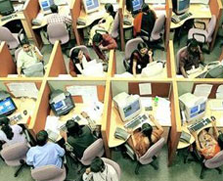
The domestic Business Process Outsourcing (BPO) market, with a growth rate of 50 per cent over five years, grew faster than the exports market to reach nearly $1.6 billion revenues in the financial year 2008. Though it is smaller than the $11-billion BPO exports market, it is expected to reach $6 billion by 2012, according to a new Ernst and Young (E&Y) study. The BPO sector’s exports depends heavily on North America and the UK, which account for 87 per cent of total exports revenue. With these two economies having been hit badly, the growth rate for exports is expected to fall further. But, if it’s “business as usual mode”, India’s BPO exports will touch $28-30 billion over four-five years, states the report.
 |
The domestic BPO market, hence, presents a huge untapped growth opportunity. Its addressable market opportunity is in the range of $16-19 billion by 2012, with significant business growth coming in from sectors like BFSI (banking, financial services and insurance), telecom, media, retail and government sectors. “Outsourcing is not new to India. Indian companies have been doing this for a long time now. But what we were surprised to find was the depth and scope of portfolio outsourcing firms are ready to consider,” said Milan Seth, partner, technology practice, E&Y.
Eighty per cent of the industry comprises captive shared service centres. The rest of the industry is highly fragmented. Estimates suggest that 650-700 firms constitute the unorganised sector. Over the next few years, the market will be consolidated and 8-10 large vendors will dominate it, says Seth. Indian IT biggies, such as Tata Consultancy Services, Infosys and Wipro, are increasing their focus in this segment. India’s second-largest IT firm Infosys recently announced its foray in the domestic market, with Wipro expected to join soon.
Global players like IBM Daksh, Firstsource, MphasiS BPO and Intelenet Global Services are also planning to significantly expand their presence in this market. Firstsource’s revenue contribution from the domestic market has grown from 3.8 per cent in FY07 to 10.8 per cent in FY08. Similarly, the NYSE-listed Genpact has signed up four customers among the Indian financial services segment. Likewise, the Nasdaq-listed EXL Services is understood to be scouting for local buy-outs. Although domestic suppliers offer an entire portfolio of services, as offered to international markets, the domestic market has limited services currently. According to a leading domestic provider, 90 per cent of this business is voice-based and 10 per cent non-voice based. Hence, customer care and sales & marketing are the two largest service-line segments, having accounted for over 70 per cent of the overall market in 2008. However, services like HR and finance & accounting are expected to have a positive growth in the next two-three years.
However, margins and cost structures will remain a challenge for service providers. Entry-level salaries for domestic BPO are between $135-182 per month (around Rs 6,340-8,550) and wage costs have been increasing at 10-12 per cent annually. “As compared with export-oriented BPOs, the annual revenue per full-time employee is 2.5 times in favour of export BPOs. |
|
|


