|
|
prospects for FDI inflows look promising
MORE
[+] |
 |
|
2008 Initiatives for Overseas Indians
MORE
[+] |
New Year Greetings
At the outset we take this opportunity to wish all readers of the ‘India Chronicle’ and their families a very happy and prosperous New Year 2009.
|
|
| |
|
| |
President Dmitry Visits India
05 Dec 2008, New Delhi |
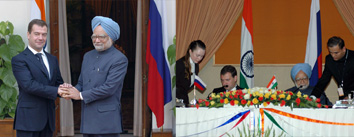
1. The Prime Minister, Dr. Manmohan Singh meeting the President of Russia, Mr. Dmitry A. Medvedev 2. The President of Russia, Mr. Dmitry A. Medvedev and the Prime Minister, Dr. Manmohan Singh signing the Joint Declaration between the Russia and India |
The last month of 2008 witnessed a significant event - President Dmitry Medvedev paid a successful State visit to India on 4-5 December. He met President Smt. Pratibha Devisingh Patil, and Prime Minister Dr. Manmohan Singh. Vice President Shri M.H. Ansari, External Affairs Minister Shri Pranab Mukherjee, UPA Chairperson Smt. Sonia Gandhi and the Leader of Opposition Shri L.K. Advani also called on him. President Medvedev held extensive discussions with Prime Minister on bilateral and international issues. A total of ten documents including those in the areas of civil nuclear energy, space, customs, financial security and bilateral business were signed. President Medvedev also presided over the closing ceremony of the ‘Year of Russia in India’ together with the President of India.
President Medvedev was the first foreign Head of State to visit India after the Mumbai terrorist attacks, and the issue of terrorism was discussed at President Medvedev’s meeting with the Prime Minister in New Delhi. Russia expressed its readiness to cooperate with India in every possible way in punishing the perpetrators of the terrorist acts. Earlier, the Russian President and the Prime Minister conveyed their condolences to the President and Prime Minister of India on November 27 and 28, respectively. The Prime Minister of India in his message on 9 December thanked President Medvedev for his condolences over the terrorist attacks in Mumbai, and for expressing his support and sympathies to the Government and the people of India. National Security Advisor Shri M.K. Narayanan also conveyed his gratitude in a message to Mr. Nikolai Patrushev, Secretary of the Russian National Security Council in response to his message of condolences and shock at the barbaric and inhuman terrorist attacks in Mumbai.
India and Russia strengthened their ties further by inking 10 agreements, including a pact on civil nuclear cooperation and decided to intensify their cooperation in combating terrorism.
The agreements signed in the presence of Prime Minister Manmohan Singh and Russian President Dmitry Medvedev were in diverse areas ranging from space and defence to finance, human space programme and tourism. The new Russian President is accompanied by a host of officials and businessmen from various state-run and private agencies and companies.
Describing the agreement on civil nuclear cooperation as a “new milestone” in bilateral relations, Singh told a joint press conference with Russian President who is on a three-day visit, here, “The signing of the agreement on civil nuclear cooperation with Russia marks a new milestone in the history of our cooperation with Russia in the field of nuclear energy.”
Under the agreement, Russia will build four additional atomic reactors in the Kudankulam nuclear plant in Tamil Nadu. Russia agreed in January 2007 to help India in the construction of four energy blocks at the atomic plant in Kudankulam and nuclear power plants at new sites in India.
Separately, OAO Tvel, the Russian nuclear-fuel monopoly, agreed to deliver fuel worth $700 million to other Indian power stations.
Singh, after signing a joint declaration with Medvedev, said both the countries have taken “yet another step forward” through joint action in human space flight programme.
Russia’s space agency signed a new document with ISRO on cooperation in space exploration, which includes plans to send two Indian astronauts to space on board a Russian Soyuz spacecraft in 2013.
Observing that both countries have decided to increase the trade volume to $10 billion by 2010, Singh said they discussed the possibilities of greater cooperation between Indian and Russian companies, both in upstream and down stream sectors.
The two leaders also discussed military cooperation, including technology transfer, T-90 tanks and “issues concerning creating and selling or leasing nuclear powered submarines.”
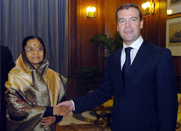
The President of Russia, Mr. Dmitry A. Medvedev meeting the President, Smt. Pratibha Devisingh Patil |
The two countries signed accords on the sale of 80 MI-17V-5 helicopters to India and cooperation in areas including space exploration, financial markets and tourism.
According to Rosboronexport officials, the helicopter deal is worth more than $1 billion.
The Russian leader expressed hope that the arms agreement would be extended for the next 10 years. “Our prime task is to move from buy-sell to joint production and development” in missile and aircraft development, he said. “Some issues remain, but there are not many of them,” Medvedev said. “We have agreed that we will keep these issues under joint control and we’ll fully cooperate with each other.”
Russia and India have seen a growth in bilateral trade this year, which increased in the first nine months of 2008 by 41.6% to $3.8 billion dollars year-on-year.
The two countries plan to increase trade to $10 billion by 2010 from this year’s expected level of $7 billion, and diversify economic cooperation in the future.
Both the countries, partners in the BRIC nations, which also include China and Brazil, are looking to boost trade to $10 billion by 2010.
The visiting leader, last month in Sao Paulo said that the BRIC countries should play a greater role in shaping up the new global financial architecture.
Also, Russian companies plan to enter into the exploration and extraction of natural resources with Indian partners, he said. The two sides are keen to develop relations in areas such as metals, machine building, pharmaceuticals, space, biotechnology and information technology.
Russia’s Statistics Service earlier said accumulated Indian investment in Russia totaled $821 million, including $718 million of foreign direct investment. Russia invested $18 million in India in the first half of 2008.
Both countries agreed that in the wake of Mumbai terror attacks efforts should be intensified against supporters and perpetrators of terrorism.
Joint Press Interaction by Prime Minister of India
and President of Russia |
|
India - Russia High Level Monitoring Committee (HLMC) held
The first meeting of the India - Russia High Level Monitoring Committee (HLMC) was held in New Delhi on 2-3 December 2008. The Indian delegation was led by Shri Vijay Singh, Defence Secretary while Mr. Mikhail Dmitriev, Director, Federal Services on Military and Technical Cooperation (FSMTC) of the Russian Federation headed the Russian delegation. The Committee has been formed consequent to a decision taken at the eighth meeting of the India Russia Inter-Governmental Commission on Military Technical Cooperation held in New Delhi on 29 September 2008. The Committee discussed various issues in the field of mutual defence cooperation and signed a Protocol identifying new areas for future cooperation. |
Kamal Nath Addresses India Russia CEOs Council Meeting
Shri Kamal Nath, Union Minister of Commerce & Industry, has stated that there is immense possibility for joint investments in the areas like banking, information technology, telecommunications, high-technology sectors, power, pharmaceuticals and textiles. Addressing the India-Russia CEOs Council Meeting here, Shri Kamal Nath said that India and Russia have managed to sustain strong business vibes in recent years and added that the India-Russia Forum on Trade & Investment has underscored the need for investment cooperation in a large number of sectors. “Indian companies are quickly establishing themselves in Russia and the cumulative Indian investments in the Russian economy amounted to US $ 744.1 million as of March 31, 2008”, he said. The meeting was also attended by Shri G.K. Pillai, Commerce Secretary; Shri Ajai Shankar, Secretary (IPP) apart from CEOs from both the countries. During the occasion, the Minister also launched the IBEF Website in Russian language for the benefit of Russian business community
Speaking on the occasion, Shri Nath informed that there is a strong case for Russian companies to invest in India, especially in power sector, as Russia is energy rich and India's energy requirements are going to increase manifold over the next 10-15 years.
The Minister emphasised that critical sectors of the economy, like agriculture, have started a process of revival by growing at a rate of close to 4%. This growth rate is a significant contribution to inclusiveness, which is vital for India as it helps sustain domestic consumption, which will sustain our growth story in the short, medium and long term, he added.
As regards the global meltdown, Shri Nath expressed hope that “both our economies will bounce back, because of their sound fundamentals and large domestic demand. We too are taking measures to inject growth dynamism back into our economy; we are cutting bank rates and easing statutory reserve requirements to inject liquidity into the system, we are also looking at creating demand impetus in a number of sectors, especially consumer driven industries and exported-oriented ones”.
Bilateral trade between India and Russia during 2008-09 (April-July) was to the tune of US $ 1613.56 million. Major items of export are drugs, pharmaceuticals & fine chemicals, RMG cotton including accessories, tea, coffee, tobacco un-manufactured, processed minerals, plastic & linoleum products, machinery & instruments, transport equipments, electronic goods etc. Major items of import are iron & steel, non-ferrous metals, coal, coke, newsprint, silver, synthetic & reclaimed rubber etc. |
|
PM’s Statement on the occasion of departure
for G-20 meet
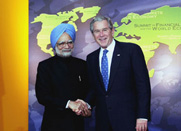
The Prime Minister, Dr. Manmohan Singh being welcomed by the US President, Mr. George Bush at the Summit on Financial Market and the World Economy, at Washington, USA |
Prime Minister Dr. Manmohan Singh participated in the G-20 meeting at Washington at the invitation of President George W. Bush. This gathering of world leaders took place against the backdrop of the financial crisis that has emanated in the United States and Europe. It has become clear over the last several weeks that the effects of the crisis are spreading. In varying degrees, all countries will be impacted. We are facing the prospect of a global economic slowdown. In a statement issued, the PM stated “I look upon the Summit as an opportunity to exchange views with other leaders on the reasons behind the recent developments and to consider what measures can or need to be taken by the international community to arrest the negative fallout. The Summit also has an important role to play in considering corrective measures to prevent future recurrence of such events. The issues involved are complex and will require sustained deliberation over a period of time.”
As a major developing economy which is getting increasingly integrated with the global economy, India has a vital stake in the stability of the international economic and financial system. I will put forward our views on the need for greater inclusivity in the international financial system, the need to ensure that the growth prospects of the developing countries do not suffer, and the need to avoid protectionist tendencies. The fundamentals of the Indian economy are strong. We have taken several measures to ensure adequate liquidity and credit in the system. I have met different stakeholders in the run up to the Summit. I am fully confident about the growth prospects of our economy. The Indian economy, in fact, has the potential to contribute to global economic growth. My participation in the Summit demonstrates this changing landscape of the international economy”. |
Rhythm Asia Concert 2008 held
In the Cultural sphere, Asian students of the People’s Friendship University, Moscow held their annual Rhythm Asia Concert 2008 on 12 December. Students from different Asian countries put up information stalls during the day within the University campus and presented cultural programmes during the evening. The Indian stall was put together by the Indian Students Association with the help of decorative and information material provided by Jawaharlal Nehru Cultural Centre (JNCC) and the Information Wing of the Embassy. Kathak students of JNCC presented a folk dance in the evening.
|
Hindustani Samaj winter celebrations held
The Hindustani Samaj, the largest organization of the Indian community in Moscow, held a function to mark its winter celebration on 19 December. The function was held at the DP Dhar Hall of the Embassy of India. Dr. Rathin Chatterjee, President of Hindustani Samaj, welcomed the members of the organization. A Kathak troupe from JNCC performed during the evening. The function was attended by about 60 guests. |
|
|