Maharaja's Palace
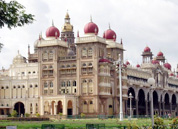
Designed by the English Architect, Henry Irwin, the Mysore Palace dominates the skyline of Mysore. A three storied structure in the Indo-Saracenic style built between 1897-1912, the palace has beautifully designed square towers at cardinal points, covered with domes. The Durbar Hall with its ornate ceiling and sculpted pillars and the Kalyanamantapa (Marriage Pavilion) with its glazed tiled flooring and stained glass, domed ceiling are worth noting. Intricately carved doors, the golden howdah (elephant seat), paintings as well as the fabulous, jewel encrusted golden throne (displayed during Dasara) are amongst the palace's other treasures. The walled palace complex houses the Residential Museum (incorporating some of the Palace's living quarters), temples and shrines including the Shwetha Varahaswamy temple. The palace is illuminated on Sundays, Public Holidays as well as during the Dasara Celebrations when 97,000 electric bulbs are used to illuminate it.
The Jaganmohan Palace
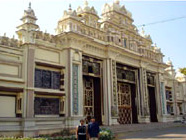
One of Mysore's most beautiful buildings, the Jaganmohan Palace was built in 1861 by Maharaja Krishnaraja Wodeyar in a predominantly Hindu style, as an alternative retreat for the royal family. This three storied palace with stained glass shutters and ventilators, in a lovely garden setting, has since 1915, housed the Sri Jayachamarajendra Art Gallery. This museum displays paintings, sculptures and musical instruments. This gallery has a collection of exquisite paintings dating back to 1875. The collection includes paintings by Travancore Ruler, Raja Ravi Varma, the Russian Svetoslav Roerich and the traditional Mysore gold leaf style of painting.
St. Philomena's Church
This is a beautiful gothic structure with twin spires, 175ft. in height, is modelled on the gothic Cathedral at Cologne. Designed by French architects, the foundation stone was laid by Maharaja Krishnaraja Wodeyar-IV in 1933. The stained glass windows made in France, overlooking the apse, showing the Birth of Christ, Baptism of Christ by St. John the Baptist, the Last Supper and the Crucifixion of Christ are works of art. The altar bears the statue of St. Philomena, a third century saint from Greece.
|
Brindavan Gardens
19 kms North of Mysore is the famous reservoir Krishnarajasagara. This Dam is built across the river Cauvery. Just below the Dam, the beautiful Brindavan Gardens are laid out. There are varieties of fountains, illuminated at night by colourful lights. The Musical fountain is of special interest which has spectacular harmony of water, colours and music.
Ranganathittu Bird Sanctuary
Ranganathittu, 18 kms from Mysore, is a Bird Sanctuary that houses exotic birds. It is a group of small islands in the Kaveri River. It is home to a variety of waterbirds, including comorants, herons, egrets and spoonbills, many of whom migrate here annually from Siberia and North America, to nest and breed. Crocodiles basking in the sun are also a familiar sight. Best season to visit this place is May-Sept/Oct.
Chamundi Hills
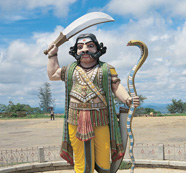
A prominent landmark, located at the outskirts of the city, Chamundi Hills can be reached by a 13 kms motorable road or 1000 steps built by the Wodeyars. At the crest of this hill is Sri Chamundeshwari Temple that dates back to the 11th century. The striking gopura (Pyramidal Temple tower) was added by Maharaja Krishnaraja Wodeyar-III in 1825-1826. Goddess Chamundi was the patron deity of the rulers. Near the temple is the statue of Mahishasura, the demon slayed by the goddess Chamundeshwari. Half way up the stone steps, is the 4.8 meter high monolith of Nandi, Lord Shiva's mount.
Somanathapura Temple
The Keshava Temple, located 42 kms from Mysore, was built in 1268 as part of an agrahara (scholastic community) founded by the Hoysala General Somanatha Dandanayaka. The temple is famous for its elaborate detail and for the fact that unlike the other Hoysala temples of Belur and Halebid, it was actually completed. This beautiful temple is enclosed within a walled courtyard, which is entered through a gate and porch. The temple is built on an elevated star shaped platform. The sides of the raised platform are richly adorned with carved freizes depicting rows of cavalry, elephants and stories from the epics. Above these is a row of large images, mainly of Vishnu in various forms. The triple-shrined (Trikutachala) monument has three sanctums, of which the north sanctum bears the image of Janardhana, the south sanctum that of Venugopala.
For more information, visit
www.incredibleindia.org
|