Joint Press Interaction by Prime Minister of India and
President of Russia
05 Dec 2008, New Delhi
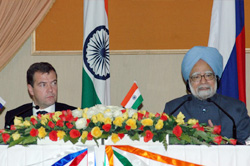
The President of Russia, Mr. Dmitry A. Medvedev and the Prime Minister, Dr. Manmohan Singh at the Joint Press Conference
|
Official Spokesperson (Shri Vishnu Prakash): Good afternoon and welcome to the Joint Press Interaction. Honourable Prime Minister of India would be making an opening statement. Next, His Excellency the President of Russia would be making a statement. Mr. Prime Minister, the floor is yours, Sir.
Prime Minister of India (Dr. Manmohan Singh): Your Excellency President Medvedev, Representatives of the media
We are honoured to have President Medvedev and his delegation in our midst today. This is a particularly historic occasion as it is President Medvedev’s first visit to India.
The President and I have held detailed talks covering all areas of our relationship such as civil nuclear cooperation, hydrocarbons, trade and economy, defence, space, science and technology, culture and terrorism.
Our strategic partnership with Russia is a vital anchor of our foreign policy. It is a relationship that has withstood the test of time. It is a relationship that is based on strong mutual trust, confidence and convergence of interests.
We are grateful for the consistent support that the leadership and people of Russia have extended to India in diverse areas.
A large number of agreements have been signed today. The signing of the agreement on civil nuclear cooperation with Russia marks a new milestone in the history of our cooperation with Russia in the field of nuclear energy.
We have taken yet another step forward in the area of space cooperation and have agreed to initiate joint activities in our human spaceflight programme.
We have given directions to our officials to expedite all measures that are required to achieve our bilateral trade target of 10 billion US dollars by 2010. This includes the activation of existing and new mechanisms such as Inter-Governmental Commission, the Joint Task Force, the India-Russia Trade and Investment Forum, and the India- Russia CEOs Council.
We discussed the possibilities of greater cooperation between Indian and Russian companies in both upstream and downstream sectors in the hydrocarbon sector. Our dialogue in this area has intensified considerably.
We have agreed to further strengthen our defence cooperation by increasingly focussing on joint production and research and development.
I conveyed to President Medvedev the sense of anger and outrage in India over the terrorist attacks in Mumbai. We deeply appreciate Russia’s expression of solidarity with India at this moment. We both agreed that these attacks represent a threat to all open and pluralistic societies, and require a major intensification of efforts against supporters and perpetrators of terrorism anywhere in the world.
Our discussions on regional and international issues were marked by strong convergence of views. There is much that India and Russia can do to enhance global peace, stability and prosperity, and bring about an international order that reflects contemporary realities.
The “Year of Russia” in India which will conclude today has been a celebration of our relations. I thank President Medvedev for joining us on this occasion.
The people of India have great goodwill for Russia. We are confident that under President Medvedev’s dynamic leadership, Russia’s leading role in global affairs will be strengthened. Thank you.
Official Spokesperson: Mr. President, the floor is yours.
President of Russia (Mr. Dmitry Medvedev): Ladies and gentlemen, first of all I would like to cordially thank the President of India Madam Patil and Prime Minister Dr. Manmohan Singh for the warm comradely welcome accorded to our delegation. Indeed this is my first visit to India in my capacity as President of Russia, and we hope that this visit will become a major element in the development of our bilateral relations, and will open a new page, important page, in our bilateral relations, our bilateral contacts.
Let me point out that for myself I have deemed it of utmost importance to ensure the continuity of good traditions of Russia-India friendship, trust and cooperation. These relations of trust have been built during the course of many centuries, and today they help us to strengthen and develop our strategic partnership. This is of particular importance during the time of test such as the terrorist attack in Mumbai. We would like once again to express our sincere condolences on behalf of our delegation to all the families of the victims, and express our solidarity in combating terrorism. We stand ready to work with our Indian colleagues in this area along all the avenues, all the areas, possible areas for cooperation. And we stand ready to provide assistance in all these areas.
Today we have had a very productive dialogue with the Prime Minister of India. Our talks have been very useful. And the main result is the demonstration of our aspiration to the development of political dialogue, cooperation in the fields of business and culture. They are reflected in the Joint Declaration that has just been signed.
One of the central topics that is usually discussed duringSsummits like this is the prospects for trade and economic cooperation. Since 2005, our bilateral trade turnover has increased. It has been increasing by a high rate, on average by one-third annually. Last year it exceeded the level of 5.3 billion US dollars and this year we expect it to reach about seven billion US dollars. And there is every reason to believe that we will be able to achieve the level of ten billion US dollars by the year 2010.
What are the main areas of this cooperation? One of the indisputable priorities is our cooperation in the energy sector. Mr. Prime Minister has referred to this. A major practical result of our meeting today has been the signing of the agreement on the construction of additional power units at the Kudankulam Power Plant, and on the construction of new Russian-designed nuclear power plants in India.
Furthermore, companies from Russia together with their Indian counterparts plan to develop exploration for and extraction of mineral resources. It is our intention to further our cooperation in metallurgy, machine engineering sector, pharmaceuticals, bio and information technologies, in the exploration of space, and development of tourism. All the documents on these subjects have just been signed. A major contribution by the way to the elaboration of these documents has been made by our Bilateral Cooperation Commission; Inter-Governmental Commission. I would like to thank the Co-Chairs of this Commission, all those who took part in its work, and the CEOs Council, and the Forum on Trade and Investment.
A part and parcel of our partnership in our cooperation continues to be military technical cooperation. Here our priority task is to switch over, to proceed from usual purchases and selling of equipment to the joint development and production. We have already some opportunities in this area and we will pursue this line. I am referring here first and foremost to our achievements in rocket engineering and aircraft engineering, and I hope that our cooperation programme will be extended for another ten years. Of particular importance to our two countries is the expansion of our humanitarian ties. The holding of Year of Russia in India has been a large-scale and impressive project. More than a 150 concerts, exhibitions, meetings with the artistes have taken place and have presented to the Indian audiences the rich palette of the Russian art. I am quite confident that the Year of India in Russia in 2009 will be equally successful, the year that will start early next year.
Our countries pursue a proactive and multilateral foreign policy. During our talks today we paid significant attention to the discussion of global and regional issues. Our approaches in addressing these problems in many respects go along the same line or are similar. And this makes it possible to tap various capabilities in the international arena in our cooperation there.
It is in our common interest to maintain peace and stability in the Asia Pacific region and in other regions. These objectives are served by the Shanghai Cooperation Organisation where a very productive role is being played not just by member countries but also by the observer countries. Their position is always appreciated and taken into account when final decisions are taken, and this is the way we evaluate the participation of India in the activities of SCO. We will continue to develop our trilateral cooperation, Russia-India-China cooperation, in various areas such as agriculture, public health, prevention of natural disasters. I think this work is of utmost importance to our countries.
There are prospects for cooperation also in the BRIC format. And what is more, the global economic crisis that is going on now creates additional incentives to continue along this path. The decisions that would be worked out in this format, on this platform, will have a direct impact given the influence of the states I have mentioned, will have direct impact on the development of global economy.
Let me also inform you that we have also discussed other topics. I have invited both the President and Prime Minister of India to visit Russia next year on official visits. This is traditional, normal practice. We meet annually, discuss versatile agenda of the whole range of our bilateral relations. I would like to once again thank the Prime Minister for the constructive and comradely dialogue that we have had. The Russian-Indian strategic partnership is indeed in full conformity with the interests of the development of our two countries, and is based on profound mutual affinity and feelings of empathy that bonds our two peoples together.
Official Spokesperson: Two questions would be taken from each side. You are requested to please introduce yourself and your organization, and indicate whom the question is being addressed to. I would request you to please restrict yourself to one question to one leader, either the President or the Prime Minister. As a courtesy to our guests, the first question goes to the Russian side.
Question (Mr. Alexandre, Arguments & Facts Newspaper): As I understand, the nuclear contract has become the first after the Nuclear Suppliers Group sanctions have been lifted. What are the prospects for cooperation in the nuclear sector, nuclear energy production? Can Russia maintain its status as India’s key partner in this area? Thank you.
President of Russia: Is this question addressed to me?
Question: Yes. But, of course, we will be interested in listening to the opinion of the Indian side as well.
President of Russia: I have just said that our cooperation in the energy sector continues to be our undisputed priority. In this context, of course, our cooperation in the nuclear energy sector is of utmost interest to us and it is very productive. We are working to construct power units at the Kudankulam site. We are fully cooperating with our Indian friends, and the results that we have already achieved are quite positive. These results have provided us with the foundation for signing a special agreement on cooperation in the construction of additional power units for the Kudankulam Power Plant and on the possible construction of new nuclear power plants in India. I think that in the present day situation, in an age when various types of energy sectors are developed in addition to traditional ones based on the fossil fuel, other sectors are also developing such as nuclear energy.
I think our cooperation cannot be overestimated because it is future-oriented, it creates new opportunities for the growth of the Indian economy and any growing economy, particularly the Indian economy which is growing quite rapidly. Any growing economy very often faces shortage of energy. And to resolve this issue, with this purpose we hope to develop our cooperation in the nuclear energy sector. That is why we are quite optimistic. We believe that we could work together and through our cooperation we could set a foundation for the development of the Indian economy at large, and we could tap the opportunities that exist today using nuclear power plants. I think that this is one of the first steps we have taken in that direction but we hope that our preparation in this area will continue to be reinforced and will advance further. We believe this cooperation to be mutually advantageous and very positive.
Question (Mr. Ranjeet Kumar, Navbharat Times): Mr. President, Sir, Indo-Russian defence relations have been passing through a rough phase in recent years. Mr. President, has your visit been able to give any forward movement to resolve the contentious issues like aircraft carrier Gorshkov and Akula class nuclear submarine, and other issues of transfer of technology for T-90 tanks. Thank you, Sir.
President of Russia: Thank you. In our military technical cooperation we have discussed it with Mr. Prime Minister. It is one of the major factors in our cooperation, one of the major elements in our business-like interaction. No doubt during our talks we paid substantial amount of time to the discussion of our military technical cooperation. This cooperation has been longstanding, it is a systemic cooperation, and it is well established by its nature. As any cooperation it has both some problematic issues and prospects. As regards prospects, I have already mentioned something about them in my introductory speech, and Mr. Prime Minister also has referred to this issue. There are certain outstanding issues but they are of working nature. There is nothing special about them. Let me just confirm specially that during hour discussion today with Mr. Prime Minister we talked very specifically, and in great detail, the issues related to technologies, related to the T-90 tanks, as well as issues related to the development and leasing for India nuclear powered submarines, and we have identified ways to resolve the outstanding problems in this area. There are very few of them but still some adjustments need to be made. We have agreed to keep these issues under our permanent consideration and we will coordinate our efforts. I believe that the discussion of these topics is very helpful.
Question (Russian journalist): My question is addressed to Prime Minister Singh. It is well known that Russia cooperates with India both bilaterally and internationally, in international organizations. Recently much has been said about preparation in the BRIC framework. How do you assess the prospects for cooperation within that organization, BRIC organization?
Prime Minister of India: India and Russia are partners in a multifaceted development, bilaterally, regionally and internationally. As far as the BRIC countries are concerned, these four countries constitute a major part of the humanity. They are also the economies which are fast-growing economies and, therefore, their development at an accelerated pace offers immense opportunities for expanding trade and investment, creating new opportunities for cooperation in energy. New areas of cooperation can be found in environment-related and climate-related issues, in disaster management, in health care and related activities.
Question (Mr. Royden d’Souza, NewsX): My question is addressed to Prime Manmohan Singh. Has India asked Secretary Rice to make a specific request to Islamabad to hand over Hafiz Saeed, Dawood, Masood Azhar and others? And what will be your Government’s line of action now against Pakistan? Will it be military, economic or political? More essentially, how long can your Government afford to be seen as being soft on terror, especially with the elections round the corner, Sir? Will it just be that two or three resignations will suffice as far as fixing accountability goes? Thank you.
Prime Minister of India: We have impressed upon all world leaders who have called me that the people of India feel a sense of hurt and anger as never seen before. Therefore, it is the obligation of all concerned to ensure that the perpetrators of this horrible crime are brought to book. That is our message to anybody and everybody who has come here or has telephoned me. We expect the world community to recognize that in this case not only we but other relevant countries have also come to the same conclusions that the territory of a neighbouring country has been used for perpetrating this crime and, therefore, the perpetrators of this crime should be brought to book. We will wait for the outcome. This was our message to Secretary Rice as this has been our message to other world leaders. We expect the international community to wake up and recognize that terror anywhere and everywhere constitutes a threat to world peace and prosperity.
Official Spokesperson: Thank you, Sir.
This brings the event to a close. Thank you very much for coming. |