|
|
PM announces a High Level Task Force on MSME Sector
MORE
[+] |
|
| |
|
| |

 1. The Prime Minister, Dr. Manmohan Singh in a group photo of the Heads of Delegations of the G-20 Summit, at Pittsburgh, USA; 2. The Prime Minister, Dr. Manmohan Singh being received by the Ambassador of India in US, Smt. Meera Shankar on his arrival at Pittsburgh International Airport to attend the G-20 Summit in US 1. The Prime Minister, Dr. Manmohan Singh in a group photo of the Heads of Delegations of the G-20 Summit, at Pittsburgh, USA; 2. The Prime Minister, Dr. Manmohan Singh being received by the Ambassador of India in US, Smt. Meera Shankar on his arrival at Pittsburgh International Airport to attend the G-20 Summit in US |
 The Prime Minister, Dr. Manmohan Singh interacting with the delegates The Prime Minister, Dr. Manmohan Singh interacting with the delegates
|
PM’s remarks at the G-20 Meeting at Pittsburgh: Plenary Session: We have discussed the complex challenges posed by the need to revive the global economy. I would like to focus on what this implies for the developing countries. We all know that these countries were in no way responsible for the crisis, but in many ways, they are the hardest hit. In the seven years before the crisis, the GDP of the developing countries grew at an average of 6.5 per cent per year. In 2009 it will grow by only 1.5 per cent, implying a fall in real per capita income.
Of course, experience varies across countries. Countries in Asia have generally fared much better. Countries in sub-Saharan Africa and in many other regions have been very badly hit.
India too has been affected but, in common with other Asian countries, we have weathered the crisis relatively well given the circumstances. After growing at 9 per cent per year for four years our economy slowed down to 6.7 per cent in 2008-09. In 2009, despite a drought, which will affect agricultural production, we expect to grow by around 6.3 per cent in 2009-10 and then recover to 7 to 7.5 percent growth next year. This relatively strong performance is partly due to the strong stimulus measures introduced in the second half of 2008-09, which have been continued in the current financial year.
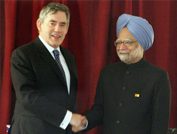
The Prime Minister, Dr. Manmohan Singh meeting the British Prime Minister, Mr. Gorden Brown, on the sidelines of the G-20 Summit |
However, the fact that some of us have fared relatively well does not mean that the crisis has not affected the developing world significantly. The fact that the growth of developing countries as a group will fall to 1.5 per cent indicates the extent of the impact.
An estimated 90 million people in the developing world are likely to be pushed below the poverty line. Lower revenues will also lead to lower levels of expenditure on rural infrastructure, health and education. This will not only hurt future growth, but also delay achievement of the Millennium Development Goals. Social and political tensions could increase, undermining the national consensus in support of much needed structural reforms and adjustment.
The prospects of convergence, which seemed bright before the crisis, have receded. We must take steps to counter these developments and restore the momentum of growth in the developing world.
First, the problem must be tackled at its root by ensuring the quickest possible return to normalcy in the global economy. This requires a commitment that we will not undertake any premature withdrawal of stimulus. We must certainly plan for an orderly “exit” when the time is right, but that time is not now. The global economy may be bottoming out, but it is not expected to reach 3% growth until the end of 2010. Full Speech |
|
Mangala oil field dedicated to the nation
New Delhi, The Financial Express

The Prime Minister, Dr. Manmohan Singh dedicating the Mangala Oil Field to the Nation, at Barmer, in Rajasthan
|
Prime Minister Dr. Manmohan Singh dedicated the Mangala oil field, located in the Barmer district of Rajasthan, to the nation. Mangalais the largest of the 25 discoveries made by Cairn Energy in Rajasthan and is the largest onshore discovery of oil made in India in the last twenty years. The three mail fields named Mangala, Bhagyamand Aiswarya have a recoverable oil reserve of 1 billion barrels.
The production at Mangalais expected to peak at 175,000 barrels a day in the next two years and would account for almost 20 % of India‟s domestic production. The three fields are expected to save the country US $ 1.5 billion annually in its import bill over the next ten years. Mangala is a success story of the joint venture between the Cairn Energy and Oil and Natural Gas Corporation Limited (ONGC). Cairn Energy has invested Rs. 100 billion in oil exploration in Rajasthan. |
Indian law firms join global league
Indian law firms are increasing their presence internationally as is reflected in the number of private equity deals they have advised in the past year. Top league legal firm AZB & Partners has advised a total of four private equity deals, while DSK Legal and Trilegal have each advised three private equity buyers, leading themselves to be ranked among top 10 law firms in the Asia-Pacific, said a study by data provider Mergermarket. The Mergermarket league table has ranked AZB in the third position, while DSK and Trilegal are in the eighth and ninth places, respectively. The value of the private equity deals that the three Indian firms did were $67 million, $61 million and $29 million, respectively. Interestingly, the largest deals were done by Japanese firm Nagashima Ohno & Tsunematsu and Korean firm Kim & Chang, as big as $1.83 billion and $1.26 billion, respectively.
“There continues to be interest in investing in India, so, while the number of deals have gone down, transactions are still happening,” said DSK partner Anand Desai. “In fact, there is a growing interest to complete deals and we are currently assisting on several deals. We have assisted in as many as 50 PE funds on deals over the past four years, including international deals,” he said. According to Trilegal partner Anand Prasad: “After some initial uncertainty in December and January, the pipeline has begun to look robust again.” “The deal sizes, however, have shrunk and investors have become conservative in their dealings,” he added. This could likely last for another 8-12 months. “These deals have essentially been in the M&A, private equity, banking, power and infrastructure and telecom space. Most deals were cross-border where we represented overseas clients,” Mr Prasad added. |
Green industry - need of the hour, says India at Green Industry Conference
Industry must recognize the importance of becoming green, as green innovation is the key to harmonizing development with sustainability.
Delivering a statement on behalf of India as head of the Indian delegation on 9th September at the International Conference on Green Industry in Asia organized in Manila by the Government of Philippines in cooperation with the United Nations Industrial Development Organisation (UNIDO)’s Green Industry Initiative and in concert with the UN Environment Programme (UNEP)’s Green Economy Initiative, UN-ESCAP’s Green Growth Strategy and the International Labour Organisation (ILO)’s Green Jobs Initiative, Shri Ajay Shankar, Secretary, Department of Industrial Policy and Promotion (DIPP), Ministry of Commerce and Industry, said that “we need to think about pragmatic and realistic approaches to the challenges of climate change and environmental sustainability, and the critical role of innovation and greening of industry. Equity, the right to development and the principle of common but differentiated responsibilities have to be the basis of our approach”.
We need to speed up the development and deployment of new green technologies across sectors so that the economies of scale bring the benefit of lower costs. Globalisation with growing openness to trade and investments facilitates this process, he said, while stressing that national policies and programmes give the appropriate country-specific sectoral focus to this collective endeavour. In this context, he mentioned India’s successful ongoing efforts to reduce energy consumption in energy-intensive industries, development of wind power and the decision to launch a Solar Mission.
The central message of the conference is: countries that follow a sustainable pattern of industrial development will be better placed to exploit the new market opportunities created by the shift towards resource-efficient and low-carbon production processes. The three-day Conference (9-11 September 2009) is expected to endorse a Ministerial Declaration and a Plan of Action that would outline the steps needed to reduce the resource intensity and greenhouse gas emissions of industries in Asia and track the progress towards a low carbon industrial future. |
|
SBI embarks on fast overseas growth
State Bank of India (SBI) announced their plans to open 40 branches in various countries during the current financial year. The bank’s growth plan overseas include opening branches in Canada, UK, US, Sri Lanka, Singapore, China, Indonesia as well as West Asia, Africa and countries in India’s neighbourhood. Presently, SBI has 132 overseas branches in 32 countries and the bank is planning to increase the contribution of overseas operations to their profitability to 10 % this year as against 8 % the previous year. SBI is also planning to set up 5 regional hubs to control their overseas operations in five geographical locations – Europe, Americas, East Asia, West Asia, Africa and SAARC. The first regional hub would be operational in London by the end of the current financial year and would exercise administrative control over branches in UK, Germany, Italy and France. |
| President congratulates Prof Venkatraman
The President of India, Smt. Pratibha Devisingh Patil has congratulated Professor Venkatraman Ramakrishnan for jointly winning the Nobel Prize for Chemistry for the year 2009. The President has said, she is very proud to hear of the news and is happy that Professor Ramakrishnan's pursuit of understanding the structure and function of the ribosome has been recognized. The President has further said that she hopes that the work will one day help in bringing better cure for those who suffer from incurable bacterial infections. |
| ICAI initiates action against Satyam auditors
Institute of Chartered Accountants of India (ICAI) has announced their decision to issue separate notices to six auditors found ‘’ prime facie guilty of professional misconduct ‘’in the Satyam Computer Services case. These notices are being served on four auditors belonging to the statutory audit team of Price Water House, Bangalore – Mr. S. Gopalakrishnan, Mr. Srinivas Talluri, Mr. Shiva Prasad and Mr. Ch. Ravindranath. Besides, the notices were also being issued to Mr. V. Srinivasu, Chief Finance Officer of the company and Mr. V. S. Prabhakar Gupta, Head of Internal Audit of the cell of the company. Notices will also be issued to New Delhi and Kolkata offices of Price Water House. These notices are being issued based on the report of Director (Discipline) of the ICAI into the role of external and internal auditors in the commission of the financial regularities in Satyam Computer Services Ltd. |
| India re-elected to UNWTO Council
India has been re-elected to the Executive Council of the United Nations World Tourism Organisation for another four-year term. The 18th General Assembly session of UNWTO was being held in Astana in Kazakhstan from October 5-8. The Executive Council is the governing body of the UNWTO which is responsible for ensuring that the organisation carries out the work and adheres to its budget. It meets twice a year and comprises 31 members elected by the General Assembly in a ratio of one for every five members. India is a member of the Executive Council continuously for the last 19 years. During this period, India has been elected to the chairmanship of the Council twice. |
|
|
|