India 2009 Election: A giant democratic exercise
They trudged through sand dunes in the searing heat, climbed icy peaks and crossed treacherous waters to reach that one goal — a polling station. From mountainous Lahaul and Spiti in the north to Lakshadweep islands in the south, officials and voters ensured that the great Indian election of 2009 was truly remarkable.
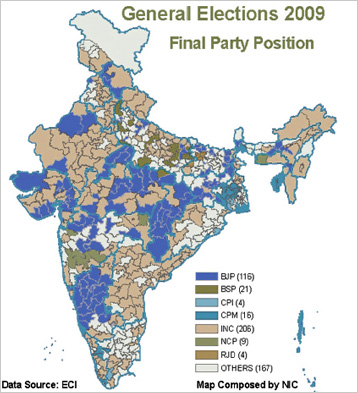
The polling officials got there and then the voters, in the world’s greatest democratic exercise that started April 16 and ended May 13, with most of the electorate of 714 million voting for a new Lok Sabha. More than 700 parties vied for power in an exercise conducted through 1.36 million electronic voting machines (EVM) in 828,000 polling stations spread across 28 states and seven union territories. Around 1.2 million security personnel were on hand to ensure that the five-phase election went off peacefully.
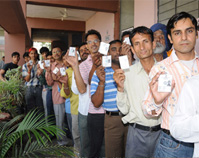
A large number of voters in a queue to cast their vote at a polling booth Davesamaj College for Women, during the 5th and final Phase of General Election-2009
|
It was a painstaking exercise that left out nobody — not even the solitary voter in the Gir forest in Gujarat. Guru Bharatdasji Maharaj was the only voter at his polling station, but three poll officials went to collect his vote. In hilly Arunachal Pradesh, there were four polling stations with just three voters each.
The poll panel said officials reached the polling stations on foot and had to travel for three or four days from the nearest helipad or road. In the mangrove forests of Sundarbans, too, voters crossed on boats the narrow creeks and water channels that criss-cross the delta, and exercised their franchise. With the entire forested region crisscrossed by rivers, the Election Commission also ferried its officials and equipment on boats. Boats were also the primary mode of transport in the islands of Andaman and Nicobar and Lakshadweep.
“The Andaman and Nicobar group of Islands is one constituency and is 700 km long. Many places require 35-40 hours journey by boats,” the Election Commission said. And, if in Minicoy Island, EVMs were ferried by helicopters, in Assam’s Sonitpur district two bullock carts were kept on standby to transport poll material as the roads were not in good shape.
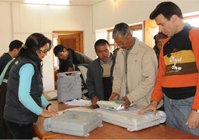
The Polling Officials collecting the EVM and other related materials for the use in the 5th phase of General Election-2009 from one of the distribution centre at Leh, Ladhakh
|
And in some areas of the state, tamed elephants were kept ready to carry polling personnel and EVMs in case of rains. If the poll officials took special steps, some voters went the extra mile to exercise their franchise. In Udaipur, a groom rode up to a polling station on a white mare, saying he had to vote on the way to his wedding.
Another man, who rode to the polling station was Bhadaru in Kasumpti, Himachal Pradesh. Why did he have to ride? Because he was 127 years old, a man who had voted in independent India’s first election in 1952. About 67 boats were used to ferry officials and polling material in voting stations located on remote sandbars along the Brahmaputra river.
It was a similar uphill task in other places too. Like in West Bengal’s Darjeeling district, where poll officials trekked 12 km up the Himalayas to reach the polling station at Srikhola. Once they reached, they had neither electricity nor piped water, just like the 692 registered voters.
In Himachal Pradesh’s tribal belt of Kinnaur as well, the ballot involved a trek through miles of rugged, cold and inhospitable Himalayan terrain and a chilly night at the polling station before election day. In Jaisalmer district in Rajasthan, the Election Commission set up six mobile booths to facilitate voters in the Barmer parliamentary constituency. |


