 The deities were adorned with glittering jewels and even the prayer items used in temples and households were beautifully designed and crafted.Everywhere in India, one finds idols and statues in temples and on the streets. For a people so given to idol worship, it was natural to develop sculpting skills of the highest order. Brasswork from the princely state of Jaipur, the black stylized vases and urns from Pembarthi and polished brass mirrors of Aranmula have today evolved into design statements. Metal and bronze sculptures of south India continue in an unbroken lineage from the Chola period dating back to a thousand years ago. The deities were adorned with glittering jewels and even the prayer items used in temples and households were beautifully designed and crafted.Everywhere in India, one finds idols and statues in temples and on the streets. For a people so given to idol worship, it was natural to develop sculpting skills of the highest order. Brasswork from the princely state of Jaipur, the black stylized vases and urns from Pembarthi and polished brass mirrors of Aranmula have today evolved into design statements. Metal and bronze sculptures of south India continue in an unbroken lineage from the Chola period dating back to a thousand years ago.
In all villages and towns, blacksmiths are intrinsic to the milieu, producing cooking utensils and stoves in addition to kitchen accessories including spatulas, knives and hammers. The spectrum of metalsmiths in India includes the simple blacksmiths serving the needs of agricultural communities to the sophisticated 'kammalar' community of metalsmiths who claim descent from Vishwakarma.
The Buddhist blacksmith community of Ladakh carry out the most interesting brass work, making kitchen stoves, 'thap chabrik', with decorative brass Buddhist motifs. Skilled blacksmiths also make sophisticated locks with up to twelve levers with beautifully ornamented keys. Locks are a speciality of Ajmer, Aligarh and Meerut.
|
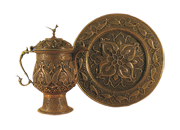
Quality work in silver, copper and brass is done in Chilling, Ladakh, where the 12th century-inspired copper ladles and ornate tea kettles are crafted. Copper
vessels are also produced in the Kashmir Valley. Copper samovars, ornamental glasses and water jugs are no't merely utilitarian but indicate a dedication to beauty. Brass, first produced in India by fusing zinc with copper, over two thousand years ago, gets its expression in Moradabad, Uttar Pradesh, the largest centre for hand engraved brass.
Engraving, the most refined of all processes, has various styl~s known as japani, mehrani, chikan and bidri. Lacquer colours in deep red, yellow, black and blue are filled in the engraving. Plates, bowls, ashtrays, of polished brass, make excellent decorative metalware.
Gujarat has a wide range of brass objects made by the 'kansara' community. Storage chests made by the kathi community in Saurashtra has diverse uses. The large 'dhablo' or 'katordan', a round casket with three stout legs and a bowl-shaped upper portion topped with a smaller box and a large brass ring on the top serves as a trousseau chest, storage pot for grain, and in olden times, for storing je~els. The entire casket tied by a strong rope passed through the rings would be lowered in a well during battles or skirmishes to protect the jewellery.
Utility items such as nut crackers, with flower motifs and animal figures, kohl containers, foot scrappers with bells, are a credit to the skill of the metalsmiths. Bell metal, an alloy of copper and tin is used extensively in Kerala to cast cooking vessels. In addition, beautiful lamps made for temples are over five feet high with circular recesses to hold the oil for lighting.The elegant bidri work of Bidar and Hyderabad has brass inlaid upon an alloy of silver and copper and blackened by dipping the object in a copper sulphate solution. This craft was brought into India from Iraq 900 years ago and continues to be practiced. The adaptable folk idiom, has produced a plethora of objects for hunting, fishing besides lamps, ornaments and toys particularly in West Bengal, Orissa and Bihar.
In their simplicity, emerges a unique view of nature through the age old processes of metalwork. The bronzes of India defY age, looking as fresh today as they would have coming out of the sculptor's mould many centuries ago. Indian bronzes speak volumes about the expertise of an art form that was born very long ago and still holds the strings of continuity in the story of Indian tradition. The earliest mention of bronze is found in the epic called the Matdya Purana. The findings in the ruins of Mohenjodaro and the discovery of the figure of the dancing girl showed that sculpture along with the use of metal alloys was well known to people of that period. |


