Russian govt to infuse $670 mn in Sistema Shyam
Kolkata, Source: Business Standard
|

Vsevolod Rozanov, president and chief operating officer, Sistema Shyam TeleServices
|
The Russian government is likely to pick up equity amounting to $670-700 million in Sistema Shyam TeleServices Ltd (SSTL), a joint venture between Russia-based telecom major Sistema and Shyam Group in India, by the end of this financial year. After the deal, Sistema, which holds a 74 per cent equity stake, might have to shed 20 per cent of it, while Shyam will maintain its 23.5 per cent stake.
"The Russian government has already approved infusing about $670 million. We are negotiating with the government regarding the stake sale and valuations. After we get the approval, we will seek Foreign Investment Promotion Board (FIPB) clearance in India," said Vsevolod Rozanov, president and chief operating officer, Sistema Shyam TeleServices, at a press conference here today to announce the commencement of the company's mobile services in Kolkata.
The JV company, which aims to have at least a 10 per cent market share in mobile services in the next five years, has prepared a capital expenditure plan of about $5.5 billion over the period in India. Of this, about 40 per cent would come through equity participation by the two companies and the Russian government, said Rozanov.
So far, the company has invested about $1.2 bn in India for spectrum allocation and other infrastructure. Sistema Shyam is hoping to have a pan-India presence by the middle of next year.
Under the MTS brand, the company now operates in Kolkata, Tamil Nadu, Kerala and Rajasthan cellular circles, with a subscriber base of 9,20,000. It will commence operations in the West Bengal circle soon, said Rozanov. "We intend to cover one circle per month. After West Bengal, we will enter Bihar and Jharkhand, followed by Maharashtra, Delhi and Haryana by December this year,” he added. Meanwhile, the company said it was planning to launch its services in Delhi by August, a move that is likely to intensify competition among the seven telecom players in the national capital.
|
Japanese cos keen to invest more in India
New Delhi, Source: The Hindu Business Line
|
Japanese corporations, scouting for partners to expand their overseas investments, are inclined to give an impetus to India as an investment destination. In a gradual shift from their earlier trading pattern, which was focussed on the US and Europe, Japanese companies expect India to emerge as the third most important trading partner after the US and China, in the next three years.
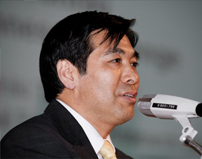
Mr Toshiki Takahashi, Director of the International Economic Research Division
|
Sharing the latest findings of a survey by the Japanese External Trade Organisation (Jetro), Mr Toshiki Takahashi, Director of the International Economic Research Division (Overseas Research Department), Jetro, said the increasing interest in India was its large market and the macro-economic strength that have helped it minimise the impact of the financial crisis.
Mr Takahashi said Japanese corporations were keen to further expand their investments in India, which not only was a huge market but also had the potential to become a cost-effective production hub.
Mergers and acquisitions : Japan’s increasing in interest since 2005 is reflected in recent mergers and acquisitions, such as of Matsushita Electric Works in electricals, Daiichi Sankyo in Ranbaxy Laboratories, and NTT DoCoMo’s investment in Tata Teleservices. Mr Takahashi said despite the global economic crisis, India figured strongly in the Japanese corporations’ outlook for investment in the next three years with 50.23 per cent of the surveyed planning to expand their business overseas, with either new investments or expansion of existing bases. This figure exceeded those planning to expand domestic operations.
An overwhelming majority, whose performance had been affected by by the financial crisis cited falling demand rising costs in the both the manufacturing and non-manufacturing sectors and forex losses as the reasons for shifting their focus of investment. In another trend, an overall declining interest in expanding sales and production functions in China, with some exceptions such as expansion in sale functions in material industries including wood, textiles, in addition to the food and beverages and precision equipment industries. Although interest in expanding sales in China was declining, stronger interest for expanding the activity was seen in India, Brazil and Russia.
|
Goldman Sachs to train 29 Indian women entrepreneurs
|
As part of its focus on developing startups across the world, Goldman Sachs is looking at training and development of around 29 select women entrepreneurs in India. The effort is part of Goldman Sachs '10,000 Women' initiative, founded on the basis of a research conducted by the World Bank, Goldman Sachs, and others, which found that educating women is one of the most effective ways to increase economic growth and improve living standards in developing economies.
According to Goldman Sachs, studies conclude that, on average, a one percentage point increase in female education raises annual GDP growth rates by 0.2 percentage point. Under the initiative, Goldman Sachs is selecting specific women entrepreneurs around the world including developing countries like India and Latin American countries.
"The public, private and non-profit sectors are convening around the idea that opening economic opportunity to women has a tremendous multiplier effect that leads to both social progress and economic growth. We are seeing a growing global movement for women’s economic empowerment. Armed with the research conducted by World Bank, the United Nations and others, we designed 10,000 Women with two goals: to provide business and management education to 10,000 Women and to increase the capacity of business education around the world by training faculty and creating 200 locally relevant case studies," said Dina Habib Powell, managing director and global head - corporate engagement at Goldman Sachs.
In India, Goldman Sachs has partnered with NEN, London Business School (LBS) and Indian School of Business (ISB). Having completed a 150-hour certificate program in entrepreneurship, including three weeks of classroom instruction and nine weeks of mentoring and on-the-job support, the select 29 women entrepreneurs have presented their business plans developed as part of the coursework which the organisation will help expand.
Powell added that in future, Goldman Sachs will be introducing a measurement system that will measure changes in participants' businesses such as revenue or employment numbers.
|
|
Investment plans up 36% to Rs 1L crore
Indian firms have drawn up investment plans of close to Rs 1 lakh crore in January, marking a rise of 36% from the year-ago period and signifying India Inc's optimism over a turnaround. But whether the money is actually spent will depend on an uptick in the global economy. According to government data, steel and electrical equipment makers lead the pack of corporates in drawing up investments in new capacities and expansion projects. The department of industrial policy and promotion has received investment proposals totalling around Rs 99,958 crore in January. This marks a 65% increase over proposals filed in December.
The government reckons that if the projects fructify, they could create about 65,000 new jobs. Among the January proposals, Rs 15,654 crore worth plans are for West Bengal, followed by Rs 15,088 crore for Chhattisgarh and Rs 13,381 crore for Orissa. Andhra Pradesh, Maharashtra, Karnataka and Gujarat are the other states where investments have been planned.
With focus on infrastructure development, especially in the power sector, investment of Rs 39,157 crore has been announced for electrical equipment and Rs 38,798 crore in metallurgical industries. Among the industries, electrical equipment, metallurgical industries, cement and gypsum products are the areas attracting the maximum investment plans. Though these are mere investment plans, the figures are yet another pointer that the worst may be over and the economy looks set for a rebound. This may sound contra-intuitive after dire predictions of a long and deep slowdown, but economists and investment bankers indeed see an uptick as early as September, or latest by December. |
Mexican multiplex chain to invest Rs 1,700 cr in India
Despite the ongoing tussle between multiplex operators and Bollywood producers, Mexican global multiplex operator Cinepolis plans to invest Rs 1,700 crore in India for its film exhibition business over the next seven years.
It has already established an Indian subsidiary that is in talks with mall developers for opening 500 movie screens by 2016. In the first phase of expansion, the company will pump in Rs 370 crore for opening 110 screens across eight locations. The company said it will open its first multiplex in India by the second half of this year.
The company plans to enter only in the emerging markets and therefore is looking at Brazil and Peru among other South American countries, after India.
A $675 million film exhibition company, Cinepolis operates over 2,000 screens globally, 90 per cent of which are located in Mexico. The company, which is currently the fifth largest theatre chain in the world, is aiming to move up in the ladder to the fourth slot and its India venture is part of the company's plans to expand its global footprint.
Cinepolis also plans to introduce the concept of a megaplex where each theatre will have up to 14 screens. "We will make India the country with our largest presence outside Mexico. We will open around 500 screens in the next seven years and for every screen, we will be spending around $700,000," Cinepolis India country head Milan Saini said today at the launch.
"We are also looking at launching our operations at a smaller scales, whereby we may convert some of the single screens into multi-screen property. There is a space constraint issue here and we have to adjust our business plans accordingly," Saini said.
Most of the fund would go in rentals and developing of screens and the amount would be funded by internal accruals, he added. |
|


