
It is believed that the Buddha wanted every Buddhist to visit the
four places that were significant in his life. Lumbini (in Nepal): his
birthplace, Bodh Gaya: where he attained enlightenment, Sarnath:
where he preached his first sermon, and Kushinagar: where he
attained Mahaparinirvana. Devout Buddhist, eager historian or
intrepid traveler, the trail certainly is a mind-blowing experience.
We begin our journey at Patna, in the state of Bihar.
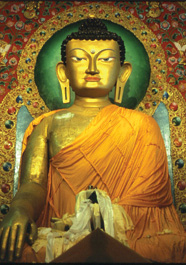
Patna, ancient Pataliputra,
is situated on the banks
of the river Ganga. Lord
Buddha came here when he
had to cross the mighty river and the
small town that stood on its banks,
Pataligram. Patna is the major entry
point for pilgrims wishing to retrace
the soulful journey of the Buddha. It is
well connected by air, rail and road to
Kolkata, Delhi, Mumbai and Varanasi.
Varanasi is located on the west bank
of the river Ganga as it flows through
the north Indian state of Uttar Pradesh.
After attaining Nirvana, Buddha
came to Varanasi in search of his five
disciples. Varanasi is 764 km from
Delhi and 678 km from Kolkata, and
is well connected by good metalled
roads. Varanasi also has an airport and
is a major railway station.
Bodh Gaya
According to Buddhist traditions, circa
500 BC, Prince Gautama Siddhartha,
wandering as a monk, reached the
sylvan banks of Falgu River, near the
city of Gaya. It was here, under a Bodhi
tree, that Prince Siddhartha attained
salvation and became the Buddha,
the Enlightened One. The Mahabodhi
Temple complex enclosing the sacred
Bodhi Tree is a World Heritage Site, as
declared by the UNESCO. Bodh Gaya
has an airport and the nearest railhead
is in Gaya (15 km). Bodh Gaya is well
connected to all the major cities in the
country by road.
Sarnath
The Buddha preached his first sermon
at Sarnath, after his reunion with his
five disciples. In Sarnath stands the
Dhamek Stupa, built on the spot where the first sermon was preached. It is
10 km from Varanasi and is well
connected by road via Varanasi with
major cities of India.
Kushinagar
Kushinagar is the place Lord Buddha
chose for the Mahaparinirvana.
The Mahaparinirvana Temple here
enshrines a 6 metre long statue of the
Buddha in the Parinirvana posture.
Kushinagar is well connected by
road via Gorakhpur with major
towns in India. The nearest airport is
Varanasi (280 km) and the railhead is
Gorakhpur (51 km).
Detour: Traveller’s Pick
While you’re on the Buddhist Circuit,
look out for these spots.
Sanchi: The massive stupa at Sanchi
with its intricately carved toranas (gateways) is noted to be a complete
example of the early Buddhist stupa
architecture in its extant form.
Buddhist site in Sanchi is one of the
World Heritage Sites in UNESCO.
Bhopal is the nearest airport to Sanchi
(46 km) and is well connected by rail
and road with rest of the country.
|
Dharamshala: Dharamsala(Mcleodganj)
is in the Kangra District of the state of
Himachal Pradesh. This hill station
with a magnificent view of the
Dhauladhar range of the Himalayas is
the seat of His Holiness the Dalai Lama.
Dharamsala is well connected by road
with Pathankot (90 km), which in turn
is connected with other major cities.
The nearest railhead is Pathankot and
the airport is at Gaggal (13 km).
Ajanta and Ellora: Situated in
Aurangabad district of Maharashtra
state, Ajanta caves house some of
the finest Buddhist paintings and
sculptures. Ellora caves carried on the
great legacy of Ajanta, and were subject
to Buddhist, and later Hindu and Jain,
influences. Ajanta & Ellora caves are
the World Heritage Sites of UNESCO.
Aurangabad, 400 km from Mumbai,
is the convenient base for visiting the
caves of Ajanta (100 km) and Ellora
(30 km). Aurangabad is well connected
by air, rail and road.
Rajgir: Surrounded by five holy hills,
the picturesque little town of Rajgir is
important for Buddhists as well as Jains.
Here, the two rock-cut caves were the
favourite retreats of the Buddha, and it was on this hill that he preached two of
his most famous sermons. The nearest
airport is in Patna (115 km) and the
railhead is in Bhakhtiyarpur (54 km). Rajgir is well connected by good roads
to Patna, Gaya, Delhi and Kolkata
(Calcutta).
Nalanda: Built on a hallowed site where
the Buddha had often stayed, Nalanda
is one of the world’s oldest living cities.
The Buddhist University of Nalanda,
once the most prestigious centre of
learning in Asia, was built here. The
evocative ruins of its monasteries
and temples still convey a vivid
impression of the serene and ordered
life of contemplation and learning
that prevailed here. Nalanda is located
14 km from Rajgir.
| FINDING YOUR WAY HERE |
Air: Indian Airlines, Jet Airways and Air-
Deccan connect Patna to the rest of the
country. There are daily flights to and
from Delhi, Ranchi, Lucknow, Mumbai and
Kolkata.
Rail: Patna Junction and Rajendra Nagar
Junction are the two main railway stations,
providing train links to Patna from other
parts of the country. There are number of
trains, including Rajdhani, linking with Delhi,
Kolkata, Mumbai, Guwahati, Bangalore and
Chennai.
Road: Patna is well connected by road
networks with the famous and important
tourist centers - Gaya (105 km), Bodhgaya
(125 km), Rajgir (102 km), Nalanda (90 km),
Vaishali and Pawapuri (90 km) - besides
other places in the region.
For more information, visit
bstdc.bih.nic.in
|
|
|
 |
Five million tourists visited India in 2007
Around five million foreign tourists had visited India in 2007 which was a big jump from the 3.92 million tourists during the previous year, Union Tourism and Culture Minister Ambika Soni said. Around 400 million domestic tourists had also travelled across different parts of the country during 2007, she said. She was speaking after declaring open the Rs 35 crore 'Zest Big Beach-Puducherry' a project of the Mahindra Holidays and Resorts India Limited (MHRIL) at Manapet coastal village.
Source: Business Standard |
| India to earn US$ 1.86 billion through medical tourism
Easy access to visa facilities permitted by India to overseas patients coupled with the best emerging medical infrastructure in large and tertiary towns will make the country earn to an extent of Rs 8,000 crore in foreign exchange by 2012, a new study has said.Currently, the earnings accrued through medical tourism annually are estimated at Rs 3,500 crore.
A comparison of the medical treatment costs of various countries shows that a procedure like bone marrow transplant costs USD 2,00,000 in USA, upto USD 2,00,000 in UK, USD 62,500 in Thailand and just around USD 20,000 in India.
Similarly, a by-pass surgery would cost USD 15,000-20,000 in USA, around USD 20,000 in UK, USD 14,250 in Thailand and USD 4,000-6,000 in India. The costs for a knee surgery in these countries are USD 16,000-17,000, 15,000, 7,000 and 1,000 respectively, the study conducted by the Associated Chambers of Commerce and Industry of India (ASSOCHAM) on Prospects of Medical Tourism for Higher Forex Earning said.
As a result of higher and very expensive medical costs in the western countries, patients from economies of scale including Africa, Gulf and various Asian countries have started exploring medical treatment in hospitals located in various well-to do places in India, Director of Gangaram hospital and one of the lead authors of the study said.
Source:
The Financial Express |
Visa norms get easier for tourists from 18 countries
Foreign tourists keen on visiting incredible India may no longer have to do umpteen rounds of the local Indian embassy to get their tourist visas. The government is considering a proposal to provide visa on arrivals to tourists coming from 18 countries, which already get five-year multiple entry visas.
These 18 countries include Argentina, Belgium, Brazil, Chile, Finland , France, Germany, Iceland, Japan, Luxemburg, Mexico, Netherlands , New Zealand, Norway, Spain, South Korea, Switzerland and Vietnam. Besides this, tourists from the United Kingdom also get a five-year visa while those from the United States of America get a 10-year visa.
Source :
The Financial Express
|
|
|


