India-Russia Bilateral Ties Going Strong
30 June 2008, New Delhi |
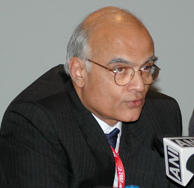
Shri Shivshankar Menon, the Foreign Secretary of India
|
June 2008 witnessed a significant political visit: His Excellency Shri Shivshankar Menon, the Foreign Secretary of India, visited Moscow on June 30, 2008. The Foreign Secretary held annual Foreign Office consultations with his Russian counterpart, Mr. Denisov, the First Deputy Foreign Minister of Russia. All aspects of cooperation between India and Russia, countries that share a strategic partnership, were discussed, including the high-level visits at the level of the Head of Government/State to each others countries between now and the first half of 2009.
The Foreign Secretary also met His Excellency Mr. Sergei Lavrov, the Foreign Minister of Russia. Foreign Secretary’s visit to Moscow underlines the importance that India and Russia attach to furthering cooperation in all areas.
General Deepak Kapoor, PVSM, AVSM, SM, VSM, ADC, Chief of Army Staff (COAS) visited Russia from 22 to 28 June, 2008. Smt Kirti Kapoor, spouse of the COAS and President of the Army Wives Welfare Association (AWWA), accompanied her husband on the visit which was at the invitation of General of the Russian Army AF Maslov, Commander-in-Chief of the Russian Land Forces. General Kapoor’s visit commenced with the laying of a Wreath by the COAS at the `Tomb of Unknown Soldier’ outside the Kremlin. Apart from meeting General Maslov, COAS also met the Deputy Chief of General Staff, the Commander of the Airborne Troops and the Commander of the Leningrad Military District for delegation-level talks. General Maslov hosted an official banquet in COAS’ honour. Several areas of mutual cooperation were discussed during the visit, and will enable a further strengthening of the cooperation between the two armed forces. These included a more active programme of exercises, and exchange of training slots for middle and senior level officers.
One of the significant developments on the commercial side was the establishment by the Indian State oil major ONGC Videsh of its Representative Office in Moscow. This is bound to provide a significant impetus to India’s cooperation with Russia in the hydrocarbons sector. India is already cooperating with Russia in Sakhalin-I. Pandit Shivkumar Sharma, the reknowned Santoor maestro, and a leading figure in Indian classical music, gave a scintillating concert at the Tchaikovsky Moscow State Conservatory on 2 June 2008. The concert marked the conclusion of the Moscow State Conservatory’s annual “Universe of Sound” Festival this year. The concert was attended by an audience of over 1200 enthusiasts, including guests from the Russian Ministry of Foreign Affairs and the Ministry of Culture, Russian media, academia and artistic circles. Pandit Shivkumar Sharma was accompanied by Mr. Rahul Shivkumar Sharma, his son, disciple and a leading Santoor exponent, and Mr. Yogesh Ratnakar Samsi, disciple of famous Ustad Alla Rakha, on Tabla. They were accompanied on Tanpura by Ms. Barkha Patel, the wife of Mr. Rahul Shivkumar Sharma. The concert was made possible by the support of the Jawaharlal Nehru Cultural Centre (JNCC) in Moscow, the Tchaikovsky Moscow State Conservatory and the sponsorship from Sberbank. Pandit Sharma also conducted a workshop for music students and faculty members of the Conservatory on June 3, 2008.
The JNCC also organized a painting exhibition of Mr. Vasily Zhivotyagov, a member of Artists’ Union of Russia on 26 June at DP Dhar Hall in the Embassy. The exhibition named the ‘Light of India’ reflected the deep influence of Indian spiritualism and philosophy on Zhivotyagov’s recent life and works, including his two visits to India since 2003. About 35 paintings were displayed in the exhibition which ranged from the depiction of an Indian mother and child, Russian mother and child, artist’s self portraits, natural beauty of his native land, and paintings touching on life which is ordinary and yet extraordinary in the sense that they reflect philosophical meanings in the larger world. The exhibition was inaugurated by the Ambassador, and a reception followed the exhibition’s inaugural.
|
India launches e-passport
25 June 2008, New Delhi |
The President launched the issuance of e-passports, also known as bio-metric passports, at a ceremony at the Rashtrapati Bhawan. Minister of External Affairs Shri Pranab Mukherjee presented the first e-diplomatic passport to the President of India, Smt. Pratibha Devisingh Patil, at the ceremony. He also presented an e-diplomatic passport to Dr. Devisingh Shekhawat. The External Affairs Minister presented e-diplomatic passports, subsequently, to the Vice President Shri Mohammad Hamid Ansari and Smt. Salma Ansari at a function at 6 Maulana Azad Road. He also presented an e-diplomatic passport to the Prime Minister Dr. Manmohan Singh at a function in Prime Minister’s office, South Block.
Continued on Page 2 |
|
Economy stronger and competitive: PM
Prime Minister Manmohan Singh said many sectors of the economy have now emerged stronger and more competitive, enabling India to grow faster despite a global slowdown. "In these past 17 years, despite the many changes in the government with different political parties wielding power in Delhi and in the states, there has been no reversal of the processes of economic reforms and liberalisation," he said at the Assocham annual general meeting here.
"Many sectors of our economy are today stronger and more competitive than ever before. This is why despite the global slowdown and the many global challenges, we face our economy is still able to deliver close to 8 per cent growth," he said. He hoped that the country will be able to sustain the growth process and overcome the challenges thrown up by the global slowdown.
Successive governments have taken forward the process of reforms and Indian economy is today more globally integrated than ever before, the Prime Minister said."Foreign trade now accounts for more than 40 per cent of our GDP. This ratio is higher than in such developed economies as that of the United States and Japan," he said.
The world recognises today that the Indian route to globalisation has been a more stable and sustainable, he said, adding, "We have avoided many of the pitfalls that other developing countries and centrally planned economies got into."
"The steady acceleration of growth, from an average of 3.5 per cent in 1950 to 1980, 5.5 per cent in 1980 to 2000, and to nearly 9 per cent since 2004, bears testimony to the wisdom of the saying, slow and steady wins the race! The Indian tortoise will win the race against many Asian hares," he said.
Source : PTI |
India the second largest newspaper market
Growing literacy and new technology have resulted in India emerging as the second largest newspaper market in the world, according to a research report by the World Association of Newspapers (WAN). The new figures show that the four largest markets for newspapers are: China, with 107 million copies sold daily; India, with 99 million copies daily; Japan, with 68 million copies daily; and the United States, with
nearly 51 million.
Indian newspaper sales increased 11.2 per cent in 2007 and 35.51 per cent in the five-year period. Newspaper advertising revenues in India were up 64.8 per cent over the previous five years. Seventy-four of the world's 100 best-selling dailies are published in Asia. India, China and Japan account for
62 of them.
Source : The Hindu |
|


