5th Intersessional meeting of Kimberley
Process held
17 - 19 June 2008, New Delhi
|
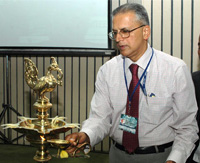
The Commerce Secretary, Shri G.K. Pillai, lighting the lamp at the Opening Session of the 5th Intersessional Meeting of Kimberley Process Certification, in New Delhi on June 17, 2008.
|
India hosted the 5th Intersessional meeting of the Kimberley Process from 17 to 19 June 2008 at Vigyan Bhavan, New Delhi. Delegates from about 35 countries attended the Intersessional meeting and participated in the various joint sessions to take stock of the progress made in implementation of KPCS and discuss ways to strengthen the Scheme. India is sixth in succession to hold the Chair of KPCS after South Africa, Canada, Russian Federation, Botswana and European Commission.
All the Working Groups of KPCS meet at the Intersessional meeting to take a half-yearly stock of the implementation of the Scheme and for planning for the year ahead. The Intersessional is structured around working group meetings and does the background work for the decisions to be taken in the Plenary. On 1.1.2008 India assumed the chair of the Kimberley Process Certificate Scheme (KPCS) for the period 1.1.2008 to 31.12.2008. In November 2006, during the plenary of KPCS in Botswana, India was unanimously selected to hold the Vice Chair of the Scheme for 2007 and therefore, Chair of the Scheme for 2008. Namibia is the Vice Chair for 2008.
Under the aegis of United Nations, KPCS is a joint Government, industry and civil society initiative to stem the flow of conflict diamonds – rough diamonds used by rebel movements to finance wars against legitimate governments. KPCS imposes extensive requirements on its members to enable them to certify shipments of rough diamonds as ‘conflict-free’. As of June 2008, KPCS has 48 members, representing 74 countries (with the European Community and its Member States counted as an individual participant). Kimberley Process Certification Scheme was adopted in a Ministerial meeting held at Interlaken, Switzerland, on 5th November, 2002. India is a signatory to the Interlaken Declaration and is a founder member of KPCS.
|
| “India to grow 40 times by 2050” |
A recent report titled "Ten Things for India to Achieve its 2050 Potential", released by Goldman Sachs, has indicated that India could be 40 times bigger by year 2050. It also mentions that India needs to implement many changes to fulfill its vision. Goldman Sachs has outlined 10 crucial steps that India must take in order to achieve its full potential. The firm's latest annual update to its Growth Environment Scores (GES), India scores below other three Bric nations, and is currently ranked 110 out of a set of 181 countries assigned GES scores . To improve further the macro variables within the GES framework, the report indicates the need to liberalise the Indian financial Markets.
The report indicates that India needs to improve its governance, control inflation, introduce credible fiscal policy, liberalise financial Markets and increase trade with its neighbours. It also needs both to significantly raise its basic educational standards, and increase the quality and quantity of its universities. The country needs to boost agricultural productivity, improve its infrastructure and environmental quality.
Delivery of all these would ensure strong, persistent, medium to long term growth, allowing India to reach its amazing potential. If India were able to undertake the necessary reforms, it could raise its growth potential by as much as 2.8% per annum. Highlighting the issue of inflation, the report indicates that although India has not suffered from dramatic inflation, it is currently experiencing a rise in inflation similar to that seen in a number of emerging economies. Targeting low and stable inflation is not easy if country's fiscal policy is poorly maintained.
The study also reveals that in terms of international trade, India continues to be much less open than many of its other large emerging nation colleagues, especially China. Given the significant number of nations with large population on its borders, India should target a major increase in trade with China, Pakistan and Bangladesh. It further states that agriculture, especially in the era of rising prices, should be a great opportunity for India. Better specific and defined plans for increasing productivity in agriculture are essential, and could allow India to benefit from the BRIC-related global thirst for better quality food.
On the issue of increasing quality of education in the country, the Goldman Sachs report says India should also have a more defined plan to raise number and also the quality of its top class universities. The setting up of the IRSMI was approved by the UIC, which felt there was a need for an international railway management institute exclusively for rail sector management.
Source: The Financial Express |
|
Suggestions on Investment in Retail Sector Invited
The Committee has already heard some oral evidence and has also undertaken on-the-spot study visits to some places. Nevertheless, the Committee would like to receive inputs from a wider cross section of stakeholders and the public at large. The Department Related Parliamentary Standing Committee on Commerce, headed by Dr. Murli Manohar Joshi, M.P., is examining the subject of “Foreign and Domestic Investment in Retail Sector”.
Those desirous of submitting their views and suggestions to the Committee may send their written memoranda (either in English or Hindi) on the above subject to Shri Surinder Kumar Watts, Director, Rajya Sabha Secretariat, 240, Second Floor, Parliament House Annexe, New Delhi-110001 (Tel: 23034240 and Fax: 23013158) or e-mail at watts@sansad.nic.in within thirty days from the date of publication of this Press Release. Those desirous of being heard in person may indicate their willingness in their written suggestions/ views. The memorandum submitted to the Committee would form part of the records of the Committee and would be treated as confidential and would not be circulated or disclosed to anyone, violation of which would constitute a breach of privilege of the Committee.
|
Microsoft to invest $20 mn in educational initiatives in India
Software giant Microsoft Corp said it will invest $20 million over the next five years in its educational initiatives in India. The company had already invested $ 20 million between 2003-08 in various education initiatives in the country. "We'll have a similar investment over the next five years," Microsoft India Chairman Ravi Venkatesan said. The company has also renewed its commitment to the India chapter of Partners in Learning, its global programme that provides the education community with resources and training. In India, the first phase of Partners in Learning so far has been Project Shiksha - which has trained more than 240,000 government school teachers from 2003 till now. In the next phase, Microsoft would aim to address national education priorities by partnering with the state governments, he said. Partners in Learning is the key education initiative for creating sustained social and economic opportunity for everyone. The other efforts that look at transforming education in India include investments in institutions, teachers and students.
Source:
The Economic Times |
|


