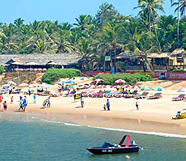
India’s finest beaches are in Goa. The Tomb of St Francis Xavier in Old Goa is a major Christian piligrimage. To some, Goa means one big non-stop party. Visitors are sure to be infected by the peppy spirit of the Carnival. The shady Goan houses and elegant Portuguese mansions in sleepy Portuguese villages, many of which you can visit, are bound to enchant.
That’s just the coast. Inland Goa, primarily Hindu, offers interesting temples around Ponda and the twelfth-thirteenth-century site of Tambdi Surla.
PANAJI
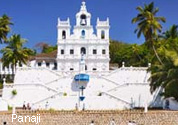
Although Panaji (Panjim) is the capital of Goa, it still has a charming small town feel to it. Sights include the Idalcao Palace, Braganza Institute, Largo da Igreja (the Main Square, dominated by the Church of Immaculate Conception). The nearby Dr Salim Ali Bird Sanctuary is a nice excursion.
The road to Old Goa from Panaji passes over a causeway that was built over a swamp in 1633 by the then Viceroy. At the end of the causeway is the attractive preserved village of Ribandar, meaning Royal Harbour. The houses, painted in evocative colours, conjure up an image of seventeenth century Portuguese Goa.
OLD GOA
Also called Velha Goa, Old Goa is the erstwhile capital of Albuquirque and the heart of Portuguese Goa. The tomb of St Francis Xavier inside the Basilica of Bom Jesus attracts millions of devout. ‘Holy Hill’ , which one passes when approaching Old Goa from the west, has a number of old churches. The Chapel of Our Lady of the Rosary (1526) is one of the oldest churches in Goa. Other sights include the Royal Chapel of St Anthony, Tower of St Augustine Church and Convent of St John of God.With a laterite facade, the Basilica of Bom Jesus is unique in Goa and a Heritage Site. It contains the remains of St Francis Xavier. The Florentine sculptor Giovanni Batista Foggini carved the saint’s tomb (1696). Every ten or twelve years the body of the saint is removed from its silver casket for public viewing.
|
Across the square, the Se Cathedral, dedicated to St Catherine, is largest church in Old Goa. Southwest of the cathedral are the ruins of the infamous Palace of the Inquisition. Short excursions from here can be made to Portuguese villages like Chandor, Rachol and Loutolim. Loutolim is home to the celebrated cartoonist Mario Miranda and his centuries old ancestral home Miranda House – is open to visitors.
NORTHERN BEACHES
Indeed, it is north of Panaji that the legendary beaches of Goa are to be found. Here’s the exclusive resort of
Fort Aguada, and the legendary Baga, the famed Flea Market of Anjuna, and quieter stretches of sand like Candolim and Arambol.
Fort Aguada
The historic Fort Aguada, the strongest of the coastal Portuguese forts, was built in 1612. At nearby Sinquerim Beach, the Taj Hotel Group has set up a Hermitage Complex. Further north, Calangute is a busy seaside town with an excellent beach.
Arambol
Once an isolated, little-known paradise, Arambol in recent years has been much visited. It’s still quiet and secluded, and boasts a fantastic stretch of sand.
SOUTHERN GOA
Margao
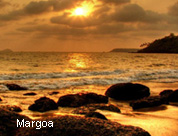
The largest commercial centre in Goa after Panaji, Margao is the capital of the state’s most prosperous taluka, Salcete. It usually serves as an overnight stop for visitors who are about to hit the beaches of South Goa, but the Baroque-style Church of the Holy Spirit, and the many fine seventeenth century houses are worth checking out.
FAIRS AND FESTIVALS
Several Christian festivals are celebrated in Goa with much gusto. These include the Feast of Three Kings, Feast of Our Lady of Miracles, Feast of St Anthony and Feast of St Francis Xavier. The largest non-religious celebration is the Carnival, marked by colourful processions complete with floats. Held for four days in February/March each year, life comes to a standstill during the Carnival, as Goa parties on as only Goa can.
“Goa means one big non-stop party. Visitors are sure to be infected by the peppy spirit of the carnival.”
For more information, visit
www.incredibleindia.org |


