Prime Minister’s Moscow visit boosts
India-Russia ties
|
Prime Minister Dr. Manmohan Singh concluded a successful three-day trip to Moscow on December 8, during which he sealed six bilateral pacts with Russia, including a broad based agreement on the peaceful use of atomic energy.
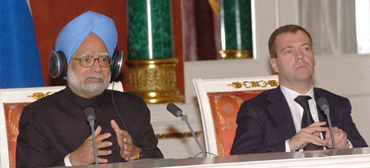
The Prime Minister, Dr. Manmohan Singh and the President of the Russian Federation, Mr. Dmitry Anatolyevich Medvedev at the Joint Press Conference, in Moscow, Russia on December 07, 2009.
|
. “Our relations with third countries will never be at the cost of time tested relationship with Russia,” Dr. Singh said in his opening remarks after meeting Russian President Dmitry Medvedev. He stressed that Indo-Russian relations have the potential to make an impact on key regional and global issues like economic revival, terrorism and climate change. Russia backed India’s concerns over terrorism, and said the perpetrators of the Mumbai terror strike should be brought to justice. Russia also condemned the terrorist attack on the Indian embassy in Kabul in October. In a joint statement signed after summit level talks between Dr. Singh and President Medvedev, the two sides emphasised “that the resurgence of the Al-Qaeda and Taliban in Afghanistan threatens the progress made over the last few years”. In the joint statement, Russia also backed India for a permanent seat in an expanded United Nations Security Council, describing India as a “deserving and a strong candidate”.
India sealed a broad-based civil atomic agreement with Russia and three key defence pacts. The nuclear pact gives New Delhi the right to reprocess spent fuel, taking the pact “far beyond the 123 Agreement” inked with the US, an Indian official said, adding that nuclear fuel supply will not be stopped in future. Among the three defence pacts was a 10-year military pact that provides for acquisition, licensed production, upgrades and modernisation of defence equipment as well as the development of new and advanced weapon systems. The two nations also “successfully” concluded a pact on the Admiral Gorshkov aircraft carrier, ending a long stand-off over the key defence deal. The two countries also signed a $100 million credit line agreement and set a target of $20 billion by 2015 to strengthen bilateral trade. A pact was also inked to increase cultural exchanges between
the two nations. |
India, Italy sign pact to enhance bilateral ties
New Delhi
|
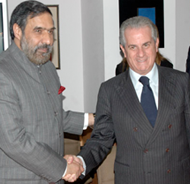
India and Italy on Monday signed a memorandum of intent to enhance bilateral economic and commercial relations. The Commerce and Industry Minister, Mr Anand Sharma, expressed the hope that foreign direct investment flow would gather momentum as the agreement would provide a single point of contact for existing and potential foreign investors. The Minister, who co-chaired the Indo-Italian Joint Commission for Economic Partnership with Mr Claudio Scajola, Italian Minister for Economic Development, said the bilateral trade between India and Italy touched $8.1 billion during 2008-09 compared with $7.8 billion in the previous year, despite the global economic slowdown. “With economy recovery clearly in sight in India, this forum could provide an impetus to take the partnership to the next higher level,” he added.
|
The Commerce Minister told his counterpart that infrastructure development is an attractive investment opportunity and a priority area for the Indian government. India has invited investment and joint ventures in Ultra Mega Power Projects, textile machinery, agricultural food processing, automotive components and wine technology. India has offered expertise in railways, IT and textiles sector.
The MoI was signed in trade and investment promotion, Indian trade missions to Italian fairs, training courses and protection of Intellectual Property Rights; FICCI Arbitration and Conciliation Tribunal (FACT) – Chamber of Arbitration of Milan (CAM) in arbitration and dispute resolution; and INVESTINDIA-SIMEST and INVITALIA in bilateral investments. Italian offer The Italian side offered partnership in e-identity cards and creation of a design centre at Ahmedabad. Cooperation in shipping and developments of ports infrastructure was also high on the agenda of the Italian side. In the renewable energy sector solar energy, waste-to-energy, second generation bio-fuels and green buildings were identified for cooperation. Both sides exchanged views about the ongoing Doha Round of negotiations and agreed that the conclusion of the round would be an important positive signal in this economic situation. |
India-Bhutan trade to maintain 15% growth
New Delhi
|
|
The bilateral trade between India and Bhutan is set to grow by more than 15 per cent in 2009-2010. The trade between the two nations has been witnessing a growth of about 15 per cent on a year-on-year basis for the last five years, according to Mr Jay P. Majumdar, Secretary General, Indo-Bhutan Friendship Association. India's exports to Bhutan was at $81 million while its imports from Bhutan stood at $119 million during the period between April and December 2009, Mr Majumdar said while speaking at a press conference to announce the formal inauguration of the Bhutan Consul General's office in Kolkata on Monday. “Power, roads and health are the key areas of co-operation between the two countries.
India has further identified newer areas and are working on environment management, tourism, agro processing, non-timber forestry, horticulture and automobiles among others,” he said. The Indo-Bhutan Friendship Association, Mr Majumdar said, was looking at establishing Indo-Bhutan Chamber of Commerce for further enhancing the trade relations between the two countries. “About 17,000 tourists from Bengal visit Bhutan every year. There needs to be greater collaboration between the two nations in tourism, health and other such sectors,” he observed. |
|
Highest ever FII inflows of US$ 17.26 billion in 2009
The number of foreign institutional investors (FIIs) registered with the Securities & Exchange Board of India (SEBI) this year has increased by 7 per cent over 2008, with record FII inflows of US$ 17.3 billion in a single year, making 2009 one of the best years in the history of the Indian stock market. The FII inflow this year broke the previous high of US$ 15.33 billion poured by foreign fund houses in domestic equities in 2007. This year, the low interest rate regime in the US and Europe enabled overseas investors to inject money into the Indian equity. According to market analysts, FII inflows in India will continue in the next year as well, given the liquidity conditions remain strong. "FIIs will continue to be positive on our markets and in general Indian markets will fare well in 2010," said Purpleline Investment Advisors director P K Agarwal. |
Anand Sharma to hold Industry Interaction and export meet at Shimla and Chandigarh
Shri Anand Sharma, Union Minister of Commerce and Industry, who was scheduled to hold industry consultations and address press conference in Shimla today and at Chandigarh on 6th January, 2010 had to reschedule the two programmes in view of the inclement weather conditions prevailing in Himachal Pradesh leading to cancellation of various flights and rescheduling of many of the train services. Shri Sharma will be visiting Shimla and Chandigarh early next month. |
UK delegation reaches out to Indian companies
An arena company is planning to set up a 30,000 seater arena in Gujarat, as part of a joint venture with an Indian company. Atlantis Resources recently forged a deal for attempting to develop tidal power projects capable of generating more than 100 megawatts of power at the Gulf of Kutch. These are a few examples of UK companies seeking to expand business relations in India. The UK Trade and Investment (UKTI) and the UK India Business Council (UKIBC) has brought in a business delegation to India to explore potential business opportunities through partnerships. Among the sectors in focus are railways and infrastructure, education and skills, renewable energy, lifesciences, biotech and pharma. What's more, as part of UK's efforts to reach out to various sectors in India, there is also a possibility of it opening a British Safety Council office in India to promote health and safety.
Operating in 50 countries, The British Safety Council is one of the world’s leading health and safety organisations and runs courses on health and safety in India. The delegation has created a nine 'emerging cities' programme, which includes events to highlight the interest and capabilities of UK companies to work with companies in Ahmedabad. Citing the reason behind looking towards India, Vicki Treadell, British Depty High Commissioner, Western India, said, "Britain is the third largest investor in India. Besides, in spite of being just 1 per cent of the world population, we produce 5 per cent of the world's science. It would be interesting to note that India's GDP is 7.9 per cent today from 6.7 per cent just a month ago. This is the place for us to do business, especially during the Dubai downturn time, India and UK can be the solution for each other." Treadell also highlighted the fact that the only way for UK to recover from the slowdown is business performance.
|
|


