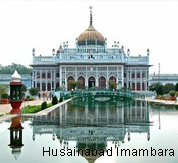
Hussainabad Imambara - Near the Rumi Darwaza, this structure houses the tombs of Muhammad Ali Shah, its builder, and of his mother. Built between 1837 and 1842, it is also called the Chhota Imambara. It is approached through a fine garden. The Imambara has a white dome and numerous turrets and minarets. The walls of the mausoleum are decorated with verses in Arabic. Chandeliers, gilded mirrors, colorful stucco, the King's throne and ornate tazia or replicas of the tombs at Karbala adorn the interior.
Shah Najaf Imambara - This white-domed structure derives its name from the town of Najaf, about 200 km south of Baghdad where the saint Hazrat Ali is buries. It is situated on the right bank of the Gomti, In this mausoleum are buried the remains of Ghazi-ud-din Haider and his wives, including Mubarak Mahal, his European wife. The entrance leads to a beautiful garden.
The silver tomb of Ghazi-ud-din Haider lies in the centre of the building and is flanked by the more imposing silver and gold tomb of Mubarak Mahal on one side, and another tomb on the other.
Residency - Built for the British Resident in 1780-1800, it was originally a very extensive and beautiful building, It was a scene of dramatic events during the War of 1857. The scarred ruins tell the story of the British community besieged by the rebels. The main house overlooks the river and is surrounded by terraced lawns and gardens.
Asafi Imambara - Also known as the Bara Imambara, it was built by Nawab Asaf-ud-Daula in 1784 and is one of the architectural highlights of the era. The central hall is said to be the largest vaulted chamber in the world. Except for the galleries in the interior, there is no woodwork used in the structure. A staircase from outside leads to a series of labyrinths which visitors are advised to visit only with authorized guides. Within the compound of the Imambara is a grand Asafi mosque.
|
Rumi Darwaza - This colossal, ornate gateway is said to be a facsimile of one of the gates of Constantinople. It was built by Nawab Asaf-ud-Daula in 1784, to create employment during the terrible famine of 1784.
Kaiserbagh Palace Complex - The construction of the Kaiserbagh Palaces was started in 1848 by Nawab Wajid Ali Shah and completed in 1850. They were built to create the eighth wonder of the world. The yellow buildings on three sides of the quadrangle, now the property of Taluqdars, once provided quarters for the ladies of the harem. In the centre stands the Baradari, a picturesque white stone edifice which was earlier paved with silver.
National Botanical Research institute - Located at Sikandarbagh, where pitched battles took place during the Mutiny of 1857, the institute garden is open to the public from 6 AM to 5 PM.
State Museum / Zoo - A favorite spot for recreation, Lucknow, Museum houses a large collection of artifacts and memorabilia and is located at Banarasi Bagh, within the zoo premises. The zoo has a large collection of animals, Museum timings : 10.30 AM to 4.30 PM Weekly holiday : Monday. Zoo timings : 5 AM to 7 PM. Other places of interest include Chhatar Manzil, Maqbara Saadat Ali Khan, Moti Mahal, Dilkusha Garden, La Martiniere, Alambagh Palace
General Information:
Area : 79 sq. km.
Altitude : 123 mtrs. above sea level.
Season : October - March
Clothing (Summer) : Cottons Winter : Woolens
Language : Hindi, Urdu, English
Local Transport : Bus/Tempo/Auto-rickshaw/Taxi Tonga/Cycle-rickshaw
Telephone Access Code :
+91 522
For more information, visit
www.incredibleindia.org
lucknow.nic.in |