
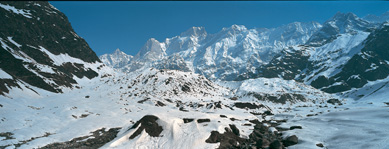
Sikkim, wedged in between Bhutan, Tibet and Nepal, may be the
most vertical place on the planet, and one of the most isolated. One
can go on for kilometers through the countryside without any signs
of habitation, and then, suddenly, on a grassy ledge at the edge of a
vast gorge, one encounters people, and a surreal scene unfolds…
An old Buddhist monk
intones prayers in a haze
of incense. Maroon-robed disciples bang drums,
shake bells and toss rice into the wind.
While you stop for sweet cardamom
tea, a group of women walking up
the hill with heavy bamboo baskets
on their backs serenades you with
folk songs in haunting voices. Small,
cherubic toddlers with angelic smiles
peep out from the baskets. Your guide translates the folk songs sung by the
women in a rapturous mix of Tibetan,
Hindi and English.
Sikkim, known to the Tibetans as
Denjong, or the Valley of Rice, has
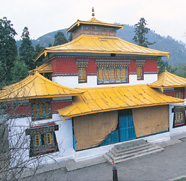
more than 250 monasteries. The
famous Rumtek Monastery is the seat
of the Gywala Karmapa, the supreme
head of the Kagyupa order of Tibetan
Buddhism. There are lamas (monks)
all over the place. We pass through
the sanatorium that houses the huge,
golden statue of Buddha. All round the
walls are rolled ancient scriptures and smaller idols of Buddha.
Thousand in
all, I am told by a passing lama. The
hall is filled with rows of scriptures
tied in ribbons. The monks sit on long
and narrow carpets with exquisitely
designed local motifs. Red is the
dominant color everywhere.
Hypnotized by the magnificent display
all around, you move outside to explore
this mystical wonderland. The town
careers wildly and very steeply up and
down the hillside; you’ll always end up
doing lots of steep climbs, and being a
lot trimmer at the end of your stay!
The people of Sikkim are simple
and friendly with a natural gaiety.
In Sikkim, tradition, hospitality and
ceremony are some of the values that
people live by on this fabled “rooftop
of the world”. EcoTrivia: Sikkim is
an ecological hotspot. Wrapped in
mists and clouds, the garden state
offers an incredible variety of orchids,
rhododendrons, gladioli, and a host of
other flowers. In spring, rhododendron colour Sikkim’s slopes, while its
gardens are abloom with hundreds of
varieties of orchids in spring and fall.
It
is a nature lover’s paradise, with many
wild life sanctuaries and parks as well.
Expect to find species unique to the
Himalayan eco-system, some of which
are endangered. Drop in at Darjeeling,
while you’re exploring Sikkim. |
Darjeeling: Located in the lower range of the
Himalayas, in the Shiwalik Hills,
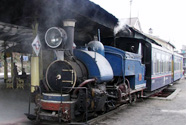
Darjeeling is home to the ‘The Toy Train’,
or the Darjeeling Himalayan Railway
(declared a World Heritage Site), plying
between Siliguri and Darjeeling, and
the setting for many a love-scene in
Indian movies. Originally just a cluster
of villages that was administered intermittently by Nepal and Sikkim,
Darjeeling became prominent in the
mid 19th century after the discovery of
the area’s suitability for growing tea.
Today, Darjeeling is a melting pot of
popular culture, and is regarded as
a niche for music lovers, especially
of the Nepali rock genre. The diverse
ethnic population is a vibrant society,
frequently celebrating festivals of
different cultures, a fascinating result
of its familiarity with not just India,
but also Nepal, Bhutan and Tibet.
| FINDING YOUR WAY HERE |
Air: The closest Indian Airport is at
Bagdogra, 124 km from Gangtok, where
scheduled flights operate to and from
Kolkata, Delhi, and Guwahati.
Rail: The closest Railhead is at New
Jalpaiguri which is around 148 km away
from Gangtok. It is connected to Kolkata,
New Delhi, Guwahati and other major
Indian cities.
Road: Gangtok is at a distance of 110 km
(4 hr) from Siliguri. Gangtok is connected
by road with Darjeeling (4 hr), and with
Bhutan, Phuntsholing (6 hr).
Darjeeling:
Air: Nearest airport is at Bagdogra (Siliguri),
a 3 hr drive from Darjeeling.
Rail: The famous Darjeeling Mail from
Sealdah (Calcutta), besides other express
trains from all over the country, connects to
the nearest railhead at New Jalpaiguri. Once
there, change over to the world-renowned “Toy Train” which winds its way up the hills
to Darjeeling.
Road: Very well connected to Siliguri. A
fleet of buses run overnight to Siliguri from
Calcutta. From Siliguri, a 3 hr scenic drive
takes you to Darjeeling.
For more information, visit
www.sikkimtourism.org
www.wbtourism.com
|
|
|
 |
Five million tourists visited India in 2007
Around five million foreign tourists had visited India in 2007 which was a big jump from the 3.92 million tourists during the previous year, Union Tourism and Culture Minister Ambika Soni said. Around 400 million domestic tourists had also travelled across different parts of the country during 2007, she said. She was speaking after declaring open the Rs 35 crore 'Zest Big Beach-Puducherry' a project of the Mahindra Holidays and Resorts India Limited (MHRIL) at Manapet coastal village.
Source: Business Standard |
| India to earn US$ 1.86 billion through medical tourism
Easy access to visa facilities permitted by India to overseas patients coupled with the best emerging medical infrastructure in large and tertiary towns will make the country earn to an extent of Rs 8,000 crore in foreign exchange by 2012, a new study has said.Currently, the earnings accrued through medical tourism annually are estimated at Rs 3,500 crore.
A comparison of the medical treatment costs of various countries shows that a procedure like bone marrow transplant costs USD 2,00,000 in USA, upto USD 2,00,000 in UK, USD 62,500 in Thailand and just around USD 20,000 in India.
Similarly, a by-pass surgery would cost USD 15,000-20,000 in USA, around USD 20,000 in UK, USD 14,250 in Thailand and USD 4,000-6,000 in India. The costs for a knee surgery in these countries are USD 16,000-17,000, 15,000, 7,000 and 1,000 respectively, the study conducted by the Associated Chambers of Commerce and Industry of India (ASSOCHAM) on Prospects of Medical Tourism for Higher Forex Earning said.
As a result of higher and very expensive medical costs in the western countries, patients from economies of scale including Africa, Gulf and various Asian countries have started exploring medical treatment in hospitals located in various well-to do places in India, Director of Gangaram hospital and one of the lead authors of the study said.
Source:
The Financial Express |
Visa norms get easier for tourists from 18 countries
Foreign tourists keen on visiting incredible India may no longer have to do umpteen rounds of the local Indian embassy to get their tourist visas. The government is considering a proposal to provide visa on arrivals to tourists coming from 18 countries, which already get five-year multiple entry visas.
These 18 countries include Argentina, Belgium, Brazil, Chile, Finland , France, Germany, Iceland, Japan, Luxemburg, Mexico, Netherlands , New Zealand, Norway, Spain, South Korea, Switzerland and Vietnam. Besides this, tourists from the United Kingdom also get a five-year visa while those from the United States of America get a 10-year visa.
Source :
The Financial Express
|
|
|


