India plans electricity network in South Asia
|
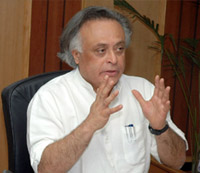
The Minister of State for Commerce and Power, Shri Jairam Ramesh addressing a Press Conference, in New Delhi on May 12, 2008. |
Aims to widen energy security; domestic firms cash in on opportunity. India is actively working on plans to build a pan-South Asia electricity ring. Aimed at broad-basing India’s energy security by wheeling back the bulk of the power generated through the inter-country power projects on the anvil, the renewed “electricity diplomacy” plans also envisage a greater play for Indian firms in harnessing energy resources across the region.While a transmission link with Bhutan is already in place, there are plans to develop two more projects in the Himalayan kingdom, besides sprucing up the existing power line, to enable up to 5,000 MW of electricity imports into India by 2020. Plans are already underway for setting up an undersea link with Sri Lanka.
In Nepal, two Indian firms - GMR Group and State-owned Satluj Jal Vidyut Nigam - are setting up hydroelectric stations, while power trading major PTC India Ltd has signed pacts to wheel power from two other projects. In Myanmar, joint development of a 1,200-MW hydro project, along with a power link, is being envisaged.“We would like to use power as a tool to ensure greater regional engagements. It is going to be a very important element of our policy going forward. Besides, Indian firms stand to gain from these efforts,” the Minister of State for Power and Commerce, Mr Jairam Ramesh, told Business Line.
Nepal base
Among the neighbouring nations, Nepal, with a hydro-electric potential 83,000 MW, of which generating 45,000 MW has been estimated as techno-economically feasible, is the biggest draw. Indian firms have started making inroads, with the GMR Group having bagged the 300-MW Upper Karnali project and Sutlej Jal Vidyut Nigam the 402-MW Arun III project. Separately, PTC India has committed to buy 750 MW from the West Seti project being developed by an Australian company and another 300 MW from the Lower Arun project being developed by a German firm. Meanwhile, over 10 Indian firms - including Tata Power, KSK Ventures, JSW Energy - are in the fray for developing the 600-MW Budi Gandaki project, for which tendering is underway.
Besides power developers, a host of Indian civil engineering firms, including Nagarjuna Construction Ltd, Continental Construction Ltd and Maytas Infra Ltd, are now in the running for contracts in Nepal.
More in line
In Bhutan, after the success of the 1,020-MW Tala project, from which power is already being wheeled into India, three new major hydro projects - the 1,080-MW Punatsangchhu-I, the 1,000-MW Punatsangchhu-II and the 600-MW Mengdechu hydro electric projects - have been identified for joint development, and the survey and investigation work has been initiated. With Sri Lanka, India is already working on putting in place a $450-million mega undersea power transmission link.
The 200-km submarine cable is likely to be set up with a capacity to wheel around 1,000 MW of electricity and State-owned Power Grid Corporation is set to bag the mandate to execute the project. NTPC, meanwhile, is already working on a 500-MW coal fired plant in Trincomalee. In the case of Burma, the Tamanthi hydroelectric project (1,200 MW) has been identified for joint development and a transmission link could be decided upon based on the progress on the project. An Indian delegation to Myanmar is expected to leave in the first week of June to discuss further action on the proposal.
Source: The Hindu Business Line |
| Indian companies lapping up coal fields abroad |

C Sivasankaran, the chairman of the Sterling group |
Coal has become a hot property with India Inc. Just sample this: India Cements wants coal mines abroad, rookie NRI businessman C Sivasankaran wants one too, Reliance Power and GMR just got one while the Tatas already have it. Corporates are franatically lapping up coal mines from Africa to Indonesia to Australia.
The reasons for these are three-fold. First, companies want to have a complete control on the supply of coal, considered essential fuel for power plants, cement and steel units. Buying coal mines ensures supplies and brings about a security. Second, having a captive coal mine wouldn't subject the industries to the vagaries of rising prices. The near panic-buying of coal fields are showing up on the price of coal as well. The prices have doubled in the past three months to peak at $350 a tonne. Third, corporates buy mines to ensure quality of coal and also drive in efficiencies in mining.
The power sector accounts for 75-80 per cent of total coal demand and coal requirements for power generation is estimated to be in the region of 500 to 540 million tonnes by 2013.According to some studies, coal demand from power generation companies is likely to outstrip domestic supply by atleast 55 to 60 million tonnes by 2013 and in two years from thereon the shortfall could increase to 100 million tonnes.
A quick glance at coal mine buys by Indian companies show that Indonesia is the first port of call. In March, Reliance Power announced that it acquired three mines in Sumatra, Indonesia. The estimated reserves in these mines are in the range of two billion tonnes. Binani Cements is in negotiations with PT Berau of Indonesia to aquire coal mines. Rough estimates suggest that the shopping cart would be in the region of $100 million.
California-based Regulus handles over 2.1 billion paper and electronic transactions annually. It operates through 10 processing centers in California, Georgia, Illinois, New Jersey, North Carolina, Iowa and Texas. Regulus has around 1,300 employees and serves around 150 clients through its direct sales force and about 85 additional clients generated through reseller partnerships.
ETA Star Group and Surana Industries announced their acquisitions in January this year, while Knowledge Infra Systems, AMR Group and Madhucon Industries have declared their access to coal mines there. Tata Power signed a deal in March last year to buy 30 per cent stake in two major Indonesian therman coal producers, both promoted by PT Bumi Resources for $1.1 billion. While Tata Steel had purchased coal mines in Queensland, Australia with a 5 per cent stake in Carborough Downs Coal project.
GMR Group struck a deal with South African Homeland Mining and Energy SA wherein the Indian entity acquired 5 per cent stake for $15 million and also has options to raise its stake up to 50 per cent. The total value of the deal including options is approximately $155 million. Besides Coal Ventures International has completed due diligence for two blocks in Mozambique and has invited EoI from investment bankers to help acquisitions of coal mines in Australia, Canada, the US, Mozambique, Zimbabwe and South Africa. Tata Steel acquired 35 per cent interest in two of Riversdale's key Mozambique exploration tenements. The estimated value of the transaction is $88 million. All acquisitions have made coal assets pricier.
Source : The Times of India |
|
Hospital chain also plans re-entry in Sri Lanka, expand operations in Africa
Medical care services provider Apollo Hospitals group said on 30 April it will invest about Rs1,000 crore in the next 18 months to set up 15 hospitals in tier-II and tier-III cities in India. The hospital chain, which seeks to expand overseas, is also planning to re-enter Sri Lanka besides expanding operations in Africa. “The idea is to set up tertiary hospitals in tier-II and tier-III cities, we plan to set up about 15 hospitals in next 18 months with an investment of about Rs1,000 crore,” Apollo Hospitals Group chairman Prathap C Reddy told reporters here on the sidelines of CII annual session. He said on average these hospitals would have around 200 beds and in the next 18 months, the group is looking at 10,000-bed capacity.
Commenting on overseas expansions, Reddy said, the group is planning to re-enter Sri Lanka again.“We have written to the Sri Lankan government and this time around, we will have 51% or more stake,” Reddy said. Apollo hospitals earlier had operations in Sri Lanka in which they had minority stake and it had to abandon the project following the takeover by Sri Lankan business tycoon Harry Jayawardene. On the groups plan in Africa, Reddy said Apollo is looking to have presence in five African countries including Nigeria, Tanzania, Angola,
Ghana and Uganda.
|
Berger Paints acquires Polish firm for
US$ 38.12 million
Berger Paints India signed an agreement with Advent International, a global private equity group, to acquire 100 per cent of Bolix SA (Bolix), a leading provider of external insulation finishing system (EIFS) in Poland, for an estimated Rs 154 crore ($38.6 million). The acquisition will be made through a wholly-owned subsidiary of Berger Paints India in Cyprus. The company will seek clearance from the Polish Anti-Monopoly Office to fulfill the acquisition formalities.Bolix is the largest provider of EIFS systems in the B2B segment in Poland and neighbouring countries such as Ukraine, Russia and the Baltic states. Ernst & Young, India and Tomozak & Partners, Poland advised Berger on the transaction.
Berger Paints reported net profits of Rs 23.2 crore and net sales of Rs 356 crore in Q3' 08. The company is establishing an automotive paints plant in Jejuri, Pune at an investment of Rs 50 crore and this is scheduled to be operational by December this year. This apart, the company is working on expanding its solvent-based paint and resin manufacturing plant in Goa, besides the water-based paint and resin facility at Rishra in West Bengal.
Source: livemint.com |
Foreign oilfields investment yeilds US$ 9.89 billion in returns
India's investment in taking stakes in oil and gas fields abroad has given back Rs 40,000 crore in returns, the Rajya Sabha was informed on Tuesday. Replying to supplementaries during Question Hour, Minister of State for Petroleum and Natural Gas Dinsha Patel said ONGC Videsh Ltd, the overseas arm of state-run Oil and Natural Gas Corp (ONGC), has invested over Rs 21,000 crore overseas and OIL-IOC combine invested over Rs 2,000 crore.The investments have cumulatively yieled 28.14 million tonnes of oil and oil equivalent gas. "Rs 40,000 crore has been recovered (from these investments)," he said.State-run companies have acquired exploration and production assets in i23 countries including Australia, Brazil, Colombia, Cuba, Egypt, Gabon, Iran, Iraq, Libya, Myanmar, Nigeria, Oman, Qatar, Russia, Sudan, Syria, East Timor, Vietnam, Yemen and Venezuela.Of these, production has already started in six projects in Vietnam, Sudan, Russia, Syria and Colombia.
Source: The Times of India |
|


