India choice for International Luxury Brands
30 March 2008, New Delhi |
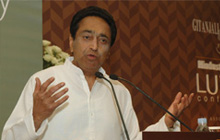
The Union Minister for Commerce & Industry,
Shri Kamal Nath addressing at the Hindustan times
Mint Luxury Conference.
|
Shri Kamal Nath, Union Minister of Commerce and Industry, during his address at the Mint Hindustan Times Luxury Conference has stated that India today is no longer a mere testing ground for international luxury brands, but a lucrative market. Quoting from the report of Global Consulting firm A T Kearney, Shri Kamal Nath informed that the report recently placed India at the top of a list of emerging markets for global retailers in its 2007 Global Retail Development Index.
“Indeed, if India was just a test market, such a high powered list of speakers would never have come for this conference! Many factors have contributed to this growth in demand for luxury goods. High salaries of employees in the corporate sector, emergence of new cities, a growing middle class, increasing number of working women, and rise of a new breed of self-employed entrepreneurs in a whole range of business sectors. Yes, we are proud of our new wealth. But let me also stress at this forum that India is a developing country with significant development challenges. The business of luxury cannot exist in a vacuum and must be seen from the overall context of equity and inclusiveness. I think it was Francis Bacon who once remarked: Money is like manure; it's not worth a thing unless it's spread around.” he added. Smt Shobhna Bhartiya, Chairperson, Hindustan times Ltd and representatives from leading luxury brands were also present on the occasion.
Explaining about the contribution to luxury Industry from an Indian Perspective, Shri Kamal Nath informed that ‘Dharavi’, which is supposed to be Asia’s largest slum also doubles up as a giant manufacturing cluster. Over the years, many migrants have moved there and have set up one-room factories, which have become extremely successful businesses. Migrants from Gujarat have established a potters' colony, and tanners from Tamil Nadu have migrated to Dharavi and set up a flourishing leather tanning industry. Other artisans, like the embroidery workers from Uttar Pradesh, started the ready-made garments trade.
The 15,000 odd one-room factories, at Dharavi manufacture products worth nearly 500 million dollars every year, a large proportion of which are exported. “My simple point of showcasing Dharavi is this: the skills of these artisans, and millions of others living in different pockets all over the country – can, and should be, effectively used by the global luxury players to develop their own low cost manufacturing bases.
To be sure, quality could be an issue in the short term. But I am sure with the right environment and training, Indian artisans can work with European companies and develop world-class products for customers all over the world, he added.As regards FDI in luxury sector, Shri Kamal Nath stated that India is keen to encourage the entry of foreign investment in the luxury sector to offer more choices to the Indian consumer. But the Government of India would like to facilitate this entry, at a pace that does not put local manufacturers and unorganized retailers at a risk.
|
| DRDO turns to NRIs to reverse brain drain |
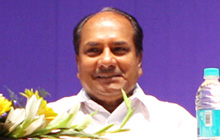
The Defence Minister, Shri A. K. Antony
|
Pack your bags, return to India and work in the cutting-edge defence technology arena to bolster the country’s military strength. Often lambasted for huge time and cost overruns in strategic projects, the Defence Research and Development Organisation now wants to add some solid NRI firepower to its armoury. After losing close to 1,500 scientists to much greener pastures of corporate world just since 2002, DRDO is stepping up its 'talent search scheme' to lure NRIs into its fold through some 'reverse brain drain'. The scheme for NRIs, though still in its infancy, has already netted at least 40 PhDs and MTechs working in academics or industry in countries like US, UK, Japan and Sweden.
"We are intensifying the drive. In 2007 alone, we received 150 applications from NRI scientists and engineers and finally picked up 22. The number of applicants is increasing, with the majority coming from US," a top DRDO scientist said. Defence minister A K Antony, on his part, told Parliament that DRDO, faced with an ‘attrition rate’ of around 7% every year, was now processing applications ‘quickly’ in the NRI talent search scheme."They are being interviewed through televideo conferencing for their quick appointment in DRDO. The process is repeated three-four times a year to increase the intake of NRIs," he said. At present, DRDO has around 6,900 scientists against a sanctioned strength of 7,255. But the greater worry is the ‘quality’ of scientists, with DRDO unable to attract bright youngsters from institutes like IITs in sufficient numbers for its 52 laboratories and establishments across the country.
It hopes to gain some ground through the NRI scheme, both in terms of quantity and quality. "The NRIs bring new knowledge, expertise, work ethic and culture," said the scientist. But will the scheme attract good talent, considering that those selected will get a carry-home monthly package of just about Rs 35,000 to Rs 45,000? DRDO seems reasonably confident of it."NRIs in the 35 to 45 age-group, having worked abroad for 10 or more years, have enough buffer money. If they want to come back to their kith and kin, we can provide them with job satisfaction," said a senior DRDO official.
"We also give value in terms of accommodation, working environment and facilities in our labs, health benefits, pension and the like," he added. Then, of course, DRDO has demanded a ‘performance-based incentive package’ for scientists, over and above the revision in salaries, from the 6th Pay Commission.
This includes proposals like a Rs 10,000 award for every patent being filed or a paper being published in a reputed journal, as also a ‘technology-transfer fee’ for every lab-to-industry transfer. DRDO scientists say Prime Minister Manmohan Singh himself has promised to them that careers in science will be made ‘more attractive from all perspectives’ to stem brain drain. Apart from fiscal and career incentives, they say the government is also considering facilitating mobility between institutions, between institutions and academia, as well as from research institutions to the production and marketing sectors.
Source: The Times of India
|
|
India to recognise foreign medical degrees
The government has decided to recognise postgraduate medical degrees being awarded in Australia, Canada, New Zealand, the United Kingdom and the United States. However, these degrees will be recognised on condition that they are recognised in the country from where it is obtained for enrolment of medical practitioners. A notification to this effect was issued on March 10 under the Indian Medical Council Act, 1956.
India already recognises medical degrees of Myanmar, Italy, Germany, Ireland, The Netherlands, Japan, and Hong Kong. The government decision is intended to overcome the shortage of medical practitioners in the country. According to the Medical Council of India (MCI), the total number of registered allopathic doctors in the country is 6,83,582 with the population ratio working out to 1:1634. In addition, there are more than 6 lakh practitioners of Indian Systems of Medicine and Homoeopathy in the country.
There are 271 medical colleges in the country, out of which 138 are in the government sector and the remaining 133 in the private sector. The MBBS students’ intake capacity of these colleges is about 31,172 and the number of seats available in various post-graduate medical courses is approximately 11,005 annually. The Centre has decided to give recognition to acclaimed postgraduate medical degrees awarded in English speaking countries. This will not only facilitate Indian students to pursue their PG medical studies in these foreign countries but will also make them eligible to practise medicine in specialised fields back in India. In addition, there are many Indian citizens who are living abroad, possessing these foreign postgraduate medical degrees and are willing to return to India. Recognition of these degrees has now cleared the way for these Indians to come back and pursue their medical profession.
Source: The Hindu |
Government gives nod to 20 FDI proposals worth US$ 490.50 million
The government has cleared 20 foreign direct investment proposals that will bring in Rs 1,962.05 crore, including Rs 924 crore by UTV Software Communications. The proposals, approved by finance minister P Chidambaram based on the recommendation of Foreign Investment Promotion Board (FIPB), also included the offer from cement manufacturer Lafarge India for merger of Lafarge India Holding Pvt Ltd with Lafarge India Pvt Ltd, according to the finance ministry.
The Lafarge’s proposal was cleared as per the order of Bombay High Court, a Finance Ministry statement said. UTV Software Communications’ proposals would bring in Rs 923.94 crore through equity purchase in UTV Software and equity shares and warrants in UTV Global. The FIPB has, however, deferred its decision on eight FDI proposals, including that of Singapore-based Delight Investments offer to invest in a Hindi-language newspaper group.
The board has recommended a proposal by Essar Power and Axis Pvt Equity to the Cabinet Committee on Economic Affairs. PSA India Pte Ltd, Singapore’s proposal for induction of foreign equity up to 49 % for Rs 240 crore by way of preferential allotment of compulsorily convertible preferential shares has also been approved.
Chidambaram also approved Rs 300 crore FDI proposal of Mauritius-based GS Strategic Investment Ltd to induct foreign equity up to 20 per cent in a company engaged in commodity broking, besides other activities.
However, the proposal of Kim Eng Securities to undertake stock-broking activities as a non-fund based activity was rejected apart from Meta Telecom to increase foreign equity from 40 per cent to 73.45% in a company engaged in international long distance services. |
|


