Continued from Page 1
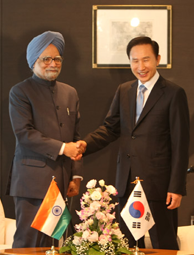
The Prime Minister, Dr. Manmohan Singh meeting with the President of Republic of Korea, Mr. Lee Myung Bak, during the G-8 Summit at Sapporo, in Japan on July 08, 2008.
|
Food Security
9. The rise in global food prices poses a new challenge to the fight against poverty and hunger. To ensure food security is a shared responsibility that calls for swift and resolute action by all Governments and relevant actors.
10. The world produces enough food, but not enough people have access to it. We call upon the international community to devise better ways and means of producing and distributing food.
Multi-billion agricultural trade-distorting support in developed countries have hampered the development of food production capacity in developing countries, critically reducing their possibilities of reaction to the present crisis. We therefore reaffirm the imperative of creating an enabling international environment for agro-produce related trade, establishing a just and reasonable international trade regime for agricultural products and concluding the Doha Round with meaningful commitments to agricultural subsidies reductions. Also, it is necessary to combat speculation and minimize the use of measures that could increase volatility of international food prices.
11. The food security crisis demands a rapid and substantial increase in the allocation of resources to support rural development and combat hunger and poverty. We urge developed countries, in particular, to increase their emergency aid at an early date. Innovative mechanisms of financing and enhanced flows of investment can also play an important role in addition to the required increase in flows of official aid.
12. Technological innovations and international cooperation can significantly increase agricultural productivity and contribute to combating the current food security crisis. Intellectual property rights in the agricultural domain should strike a balance between the greater good of humankind and incentives to innovation. In particular, we encourage collaborative action for better seeds and farm outputs that are sustainable and environmentally sound as well as a comprehensive approach in all fields including finance, trade, aid, environment, intellectual property rights and technology transfer, so as to create a conducive international environment for food security.
13. The current food security crisis has multiple and complex causes whose assessment requires objectiveness. It is essential to address the challenges and opportunities posed by biofuels, in view of the world’s food security, energy and sustainable development needs. If developed sustainably, biofuels can effectively contribute to generating opportunities and achieving food and energy security altogether. To this purpose, it is important that public policies for production of biofuels contribute to sustainable development and the well-being of the most vulnerable people and do not threaten food security.
Climate Change
14. We urge the international community to address the challenge of climate change through long term cooperative action in accordance with the United Nations Framework Convention on Climate Change (UNFCCC) and its Kyoto Protocol, especially the principle of common but differentiated responsibilities and respective capabilities. We take our responsibilities seriously and welcome the Bali Action Plan and the Bali Roadmap and are committed to the completion of negotiations by 2009.
15. Negotiations for a shared vision on long-term cooperative action at the UNFCCC, including a long-term global goal for greenhouse gases (GHG) emissions reductions, must be based on an equitable burden sharing paradigm that ensures equal sustainable development potential for all citizens of the world and that takes into account historical responsibility and respective capabilities as a fair and just approach. It is essential that developed countries take the lead in achieving ambitious and absolute greenhouse gas emissions reductions in accordance with their quantified emission targets under the Kyoto Protocol after 2012, of at least 25 40 per cent range for emissions reductions below 1990 levels by 2020, and, by 2050, by between 80 and 95 per cent below those levels, with comparability of efforts among them.
16. We also urge the international community, particularly developed countries, to promote sustainable consumption patterns and lifestyles responsive to mitigation requirements.
17. For developing countries, adaptation is of cardinal importance, particularly given their vulnerability, limited capacity and inadequate means. We stress the need of scaling up resources for adaptation and strengthening of adaptive potential in developing countries in order to reinforce capabilities to prevent and confront the increased frequency and scale of natural disasters and the other adverse effects of climate change.
18.We, on our part, are committed to undertaking nationally appropriate mitigation and adaptation actions which also support sustainable development. We would increase the depth and range of these actions supported and enabled by financing, technology and capacity-building with a view to achieving a deviation from business-as-usual. In this regard, in the negotiations under the Bali Road Map, we urge the international community to focus on the core climate change issues rather than inappropriate issues like competitiveness and trade protection measures which are being dealt with in other forums.
19.Affordable access to adaptation and mitigation technologies, achieved through a suite of funding mechanisms, investment structures and policy tools, is a key enabling condition for developing countries to tackle climate change. We call upon the international community to work towards a strengthened scheme for technology innovation, development, transfer and deployment, and a comprehensive review of the intellectual property rights regime for such technologies in order to strike an adequate balance between rewards for innovators and the global public good.
20. Enhanced financial support for developing countries must cover incremental and opportunity costs to meet the challenges of climate change. New and innovative financial mechanisms must mobilize additional resources beyond the flexibility mechanisms of the Kyoto Protocol and other instruments of the carbon market, without diverting national or multilateral and ODA resources from the imperatives of development and poverty alleviation.
21. Developed countries should commit clearly to significant additional financing to support both mitigation and adaptation in developing countries. We recognize the need for further financing options to complement, not substitute, the financial arrangements under the Kyoto Protocol. In this regard, we welcome for further exploration, inter alia, the proposal by China for setting a climate financing goal for all developed countries, such as 0.5% of GDP (in addition to ODA) for climate action in developing countries, as well as the Mexican initiative for a World Climate Change Fund
Energy Security
22. Energy security is essential to ensure the steady growth of the global economy. We call upon the international community to strengthen overall cooperation on energy development and utilization, with emphasis on renewable energy and energy efficiency and giving adequate consideration to solar, wind and hydro-electrical power, and bio-fuels such as ethanol and bio-diesel without adversely affecting food security.
23. More efforts should be made to develop clean energy technologies that are affordable, environment-friendly and suitable to the conditions of developing countries, ensuring that these technologies be adequately transferred to developing countries.
24. We must take an integrated approach to international energy cooperation and international development cooperation, ensuring access to energy by developing countries on an equitable and sustainable manner.
Millennium Development Goals and Monterrey Consensus
25. The global community of nations has recognized that achieving the internationally agreed development goals, including those contained in the United Nations Millennium Declaration, demands a new partnership between developed and developing countries.
26. This was stated in the Monterrey Consensus, whereby the international community agreed to work in a coordinated manner to support development by mobilizing domestic resources, attracting international resource flows, developing innovative financial mechanisms, harnessing the benefits of international trade, increasing international financial and technical cooperation, achieving sustainable debt financing and external debt relief, and enhancing the coherence and consistency of the international monetary, financial and trading systems.
27. As we reach with uneven success the mid-point in the process to achieve the Millennium Development Goals, particularly in the least developed countries in Africa and other regions, the international financial community should join efforts to preserve financial stability and resume the path of vigorous and sustainable economic growth as necessary conditions to attaining these goals. We urge developed countries to renew their resolve to support these processes in the global interest, particularly regarding trade openness, the fulfillment of their commitments to allocate at least 0.7% of their GNP to ODA, and the reform to global governance.
28. The international community should ensure that, from their holistic perspective, the upcoming UN Millennium Development Goals High-level event and the Doha Follow-up International Conference on Financing for Development contribute to achieving all-round and balanced progress towards the Millennium Development Goals at the global level. A follow-up mechanism to continue to monitor the implementation of the Monterrey Consensus should be one of the results of the Doha Conference.
South-South cooperation
29. We reaffirm the role of South-South cooperation in the context of multilateralism, and the need to strengthen it as an important platform for developing countries to jointly respond to development challenges.
30. We reiterate that South-South cooperation enjoys important comparative advantages and complements rather than replaces North-South cooperation. In this context, we call upon Governments, international organizations and all relevant actors, to support South-South cooperation, by fully tapping the synergies of triangular cooperation.
31. While acknowledging progress in South-South cooperation in recent years, we are committed to continue broadening its reach and impact through innovative models of cooperation based on the principles of equality and mutual benefit.
The Role of the G5
32. In fulfilling our shared responsibility as major developing countries, we are determined to continue engaging in all efforts leading to achieve the improved global economic governance and other major global changes required to ensure that globalization and interdependence work for the benefit of all.
33. We thus commit ourselves to a strengthened multilateralism, keeping fully engaged to intensified international cooperation under the leadership of the United Nations. We will continue to strive for a comprehensive reform of the United Nations that includes strengthening the General Assembly, revitalizing ECOSOC, reforming the Secretariat, strengthening the UN gender architecture and, in particular, achieving an early reform of the UN Security Council. We urge the international community to faithfully implement the outcomes of major World Summits, especially the Millennium Development Goals,
34. the Monterrey Consensus and the Johannesburg Plan of Implementation and to continue promoting shared initiatives to rise to the new global challenges and opportunities of our era.
35. As a key strategic objective, we will continue contributing to multilaterally promote an action-oriented global partnership for equitable and sustainable development, including by making positive contributions in such critical areas as global governance, financial stability, climate change as well as food and energy security.
36. With these purposes, based on the principles of equality, mutual respect and cooperation for the common good, we are ready to consolidate bilateral relations, improve our cooperation level and mechanisms, and continue the dialogue and collaboration with the G8 and the international community at large. |


