Insurers see higher FDI limit
24 July 08, New Delhi
|
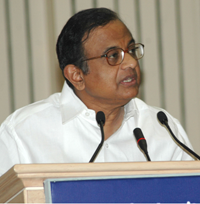
Finance Minister P Chidambaram
|
A day after Manmohan Singh won the trust vote, sans Left support, rating agencies Moody's Investor Services and Icra said the insurance sector will get a huge boost if the government paves the way for greater foreign participation in Indian companies.
Analysts said liberalising foreign investment will particularly help the life insurance business in India, where the capital requirement is higher compared with the general insurance sector.
The statement came along with an indication from Finance Minister P Chidambaram that the government will now reach out to political parties like the Bharatiya Janata Party, which had voted agaist the government confidence motion, for faster economic reforms and passage of Bills.
At least three Bills for opening up the pension, banking and insurance sectors have been pending for lack of support from the Left. The finance ministry is ready with a Bill to amend the law, which among other things will raise the foreign investment ceiling from 26 per cent to 49 per cent.
"Raising the foreign investment limit will allow higher capital inflows for the industry. We may not feel the need for higher capital right now, but in the long term, as the industry grows in size, foreign capital will become indispensable. Raising foreign cap will give more access to the international markets," ICICI Prudential Life Insurance Managing Director and CEO Shikha Sharma said.
SBI Life Managing Director and CEO U S Roy added that the move will help companies deploy capital across various segments of the business. "It is a signal that we are open to developing the Indian insurance industry. But the government will need to make a lot of changes on the regulation front as well to increase the limit to 49 per cent."
With a rise in the ceiling, the government and the insurance regulator will have to rework the guidelines, which require the Indian partner to divest stake to the public after 10 years of incorporation, an executive said.
At a time when Indian companies have mega expansion plans, more capital from the foreign partner will help them tide over whatever liquidity issues that they may be facing, though almost all the Indian promoters are large conglomerates with insurance being a smaller part of the business. The regulations mandate a solvency margin of 150 per cent. |
| India relaxes offshore vessel hiring rules for oil explorers |
April order reversed; firms can again hire foreign-registered ships older than 25 years, subject to conditions India has relaxed tight hiring rules announced in April for ships registered outside the country that are used for exploring and drilling for oil and gas off its coast, on the back of lobbying by oil firms and foreign shipowners. Companies can now hire offshore vessels that are more than 25 years old, subject to certain conditions, the country's maritime regulator, the Directorate General of Shipping, said on 22 July. Offshore vessels such as jack-up rigs, anchor-handling tugs, accommodation barges and supply vessels play a key role in the hunt for oil and gas.
The presence of older foreign ships had helped India's biggest oil explorer, the state-run Oil and Natural Gas Corp. Ltd, or ONGC, to hire 30 offshore vessels in a five-year contract beginning March 2007 at 30-40% below market rates, according to industry body Indian National Shipowners Association, or Insa. Currently, there are 165 ships operating off India's coasts, mainly servicing the country's oil and gas exploration and production firms. A majority-more than 90%-of these will reach 25 years in one-two years, Insa estimates.
Local laws give preference to India-registered ships, and foreign-registered ships can only be hired if Indian vessels are in short supply. Local shipowners are unable to meet rising demand for vessels from oil explorers, including Reliance Petroleum Ltd, Gujarat State Petroleum Corp. Ltd, Hardy Oil and Gas Plc., Cairn India Ltd, British Gas India Pvt. Ltd and ONGC. "Offshore vessels are not available because of increased activity globally due to high oil prices. The relaxation will make available more offshore vessels for hire," said Sunil Arora, a deputy general manager looking after offshore logistics at ONGC. The state-run firm needs around 300 offshore vessels of various kinds for its oil exploration and drilling activities.
Only about 30% of India's offshore vessel needs are supplied by Indian shipowners such as Shipping Corp. of India Ltd, Great Offshore Ltd, Greatship (India) Ltd, Garware Offshore Services Ltd, Tag Sealogistics Ltd and ABG group. The shortage will rise further as India drills more wells, estimated at 498 by 2012 by the director general of hydrocarbons. The maritime regulator had ruled on 25 April that foreign-registered ships working within India's territorial waters have to be less than 25 years old. Ships that fulfilled this condition also needed to undergo inspection and rectification of deficiencies of hull, machinery, safety appliances and operational requirements such as staffing, before they were permitted entry into Indian waters, its order said. The directorate had, however, exempted India-registered ships as they were already licensed to ply in Indian waters by the regulator.
The April order also made it mandatory for foreign-registered ships seeking employment in India to be classed with the country's classification society, the Indian Register of Shipping, or IRS. Classification societies set rules on safety and protection of ships, confirm that designs meet these rules, survey ships during construction and commissioning, and inspect vessels at regular intervals to ensure they continue to meet International Maritime Organization requirements.
The 22 July order says the offshore oil industry can now hire vessels regardless of age on the condition that they are classified either by IRS or any of the 10 full-time members of the International Association of Classification Societies, the global body of ship classification societies. In case a vessel above 25 years is not classified by IRS, it must undergo inspection equivalent to an annual statutory survey and an intermediate audit by IRS.
Foreign shipowners had dubbed the earlier April order "discriminatory" and said the decision to ban older ships from operating along the country's coast would add to the operational costs of oil exploration and production firms. The earlier rule would have meant that oil explorers had to spent more on logistics because hiring younger ships is costlier.
Source: livemint.com |
|
$100m, six TV channels, Murdoch's new Indian bet
In a country with 340 television channels - 60 were launched this year alone - Australian media tycoon Rupert Murdoch announced the launch of another six. Backed by an investment of Rs 420 crore ($100 million) in the next 24 months, Murdoch's News Corp-owned Star TV is all set to expand its bouquet of regional channels.
"We'll invest $100 million in India in the next 12 months to set up six regional channels under the Star brand," said the chairman of Newscorp, the multi-billion dollar media conglomerate based in New York.
In Mumbai to launch the 30 Dow Jones India Titans 30 Index, which would help launch exchange-traded funds linked to the stock market, the 77-year-old magnate has a media empire with interests in television, film, pay TV, the Net, newspapers, and publishing. According to Forbes, Murdoch's individual Net Worth stands at $8.3 billion.
Viewership measurement agency, TAM Media Research says the relative share of southern regional channels for the week July 20-July 26 stood at 18.7 per cent, in comparison to 23.2 per cent occupied by Hindi general entertainment channels.
Star already has channels in Tamil, Bengali and Marathi, along with 11 other channels.
"Regional television is the future. Over a long-term period, it is a very good bet," said Shashi Sinha, CEO, of media agency Lodestar Universal.
Source: Hindustan Times |
BOA for SEZ recommends grant of 23 formal and 6 in-principle appovals
The Board of Approval of the Special Economic Zones (SEZs) met to consider proposals for setting up of Special Economic Zones and also to approve other miscellaneous requests pertaining to SEZs. A total of 34 proposals for setting up of SEZs, including 3 proposals for conversion of in-principle approvals in to formal approvals were considered The Board recommended grant of 23 Formal approvals and 6 In-Principle Approvals.
Source:
The Economic Times |
Indian Railways' profits to cross US$ 23.54 billion by next fiscal
Indian Railways' profits are set to cross US$ 23.54 billion by the next financial year. Railway Minister, Lalu Prasad, made this announcement while laying the foundation stone for the US$ 333.58 million train wheel factory at Bela, Bihar. The Bela factory will produce one lakh wheels annually. Indian Railways has posted a 22.80 per cent rise in its revenue earnings for the July 11-20, 2008, period against the corresponding period last year.
The overall estimated earnings of the Railways on originating basis during the same period was US$ 494.84 million against US$ 403.16 million during the same period in 2007. Correspondingly, the entire goods earnings has increased from US$ 273.98 million during July 11-20, 2007 to US$ 339.50 million during July 11-20, 2008, posting an increase of 23.85 per cent, according to an official release. The overall passenger revenue earnings during July 11-20, 2008, was US$ 141.51 million against US$ 115.70 million against the corresponding period last year, registering a 22.30 per cent rise.
Source: IBEF |
|


