Backwaters of
Kerala
The Kerala Backwaters are a chain of
lagoons and lakes lying parallel to the
Arabian Sea. This network includes
five large lakes, including Ashtamudi
Kayal and Vembanad Kayal (The
word ‘kayal’ in Malayalam means
lake) linked by 1500 km of canals,
both manmade and natural, fed by
38 rivers, and extending virtually
over half the length of Kerala.
The Vembanad Lake is the largest
of the lakes, covering an area
of 200 sq km, and bordered by
Alappuzha (Alleppey), Kottayam,
and Ernakulam districts. The port
of Kochi (Cochin) is located at the
lake’s outlet to the Arabian Sea.
Alleppey, known as the ‘Venice
of the East’, has a large network of
canals that meander through the
town. Ashtamudi Lake is located
in Kollam District, and the town of
Kollam (Quilon) lies at its outlet.
The famous Snake Boat Race, known
as ‘Vallam Kali’ in local parlance,
is held every year in August to
September in these backwaters and
is a major attraction.
Ashtamudi Lake is a freshwater
lake in the Kollam district of
Kerala. Ashtamudi means ‘eight
branches’ in the local language of
Malayalam. This name is indicative
of the lake’s topography: a lake with
multiple branches.
Kalarippayat
Kalarippayat is the oldest existing martial art form indigenous to Kerala, with a history dating back 3,000 years. The term Kalarippayat is formed joining two words ‘kalari’, meaning gymnasium, and ‘payattu’, meaning to fight or exercise. Every village in Kerala had a ‘Kalari’ run by a master addressed reverentially as the ‘Gurukkal’.
The sumptuous “Sadya”
“Sadya”, a traditional, vegetarian
meal served on a green banana leaf,
is served at Kerala weddings and
during the Onam festivities, and is
relished by non-Keralites as much as
by the Malayalis themselves. Today,
the sadya is recognised as an integral
part of Kerala culture. A sadya is
served in stages, each punctuated by
the serving of a delicious payasam (a
dessert made of milk, jaggery, rice,
coconut, etc), commencing with the
all-time favourite ‘ada prathaman’
and followed at different stages of
the meal by other equally exotic
payasams, including the deliciously
sweet and creamy ‘pal payasam’.
Kutiyattom or
Koodiyattam
‘Kutiyattom’, or ‘Koodiyattam’, as
known in the local parlance, is
perhaps the only surviving art form
of our ancient Sanskrit theatre. The
word ‘Koodiyattam’ literally means ‘acting together’, with more than one
character on stage. The Koodiyattam
dance performances are closely allied
to the temple rituals. The rituals
consist of several combinations of
rhythms played on the mizhaavu,
interspersed with invocatory songs
and dance, and leaving the stage
after reciting a benedictory verse.
The whole drama itself takes about
ten to fifteen days to perform!
Spices of Kerala
Through the ages, foreigners have
visited this enchanted spice-land to
trade in most exotic commodities -
cardamom, pepper, cloves, nutmeg, |
mace, cinnamon, ginger, turmeric,
and many other lesser known spices,
such as cassia and greater galanga. In
fact, it would not be wrong to say that
had it not been for the spices, the Arabs,
the Portuguese, the Dutch, French,
and eventually, the British, would not
have made such strenuous efforts to
first reach and then try to dominate
the spice trade, and then this part of
the world! No wonder then that it is
said, and with justification, that spices like pepper and cardamom were worth
their weight in gold. India produces
around 2.5 million tonnes of different
spices, valued at approximately US$3
billion, and holds the premier position
in the world in the spice trade. Kerala,
with its virtual monopoly over highquality
spices, is often called the ‘Spice Garden of India’.
Ayurveda
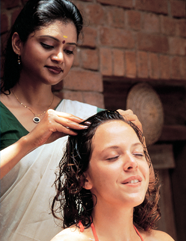
Kerala boasts of some of the finest
centres of Ayurvedic treatment, some
of which can lay claim to a continuous
tradition kept alive through the ages
by the dedication of generations of ‘aryavaidya salas’. Kerala with its yearround
salubrious climate is ideally
suited for the practice of this ancient
system of medicine. Rejuvenation
therapy, or Rasayam Chikitsa, tones
up the skin and rejuvenates and
strengthens the body’s tissues and
internal organs, thus increasing their
elasticity and strength. Kayakalpa
Chikitsa, or immunisation and
longevity treatment, involves elaborate
massages, consumption of herbal and
Ayurvedic preparations to detoxify the
body cells, and de-stressing routines
that aid the healing processes while,
at the same time, strengthening the
tissues and muscles. The Panchakarma
treatment is a combination of five
separate treatments for mental and
physical well-being. It aims at
restoring the body’s balance, and
tones up internal organs so that they
function properly.
| FINDING YOUR WAY HERE |
Air: The airports at Thiruvananthapuram, Kozhikode and Cochin receive flights from
major cities.
Rail: Kerala has an extensive railway
system, well connected with major cities all
over India.
Road: Kerala is very well connected by road
with all the major cities.
For more information, visit
www.keralatourism.org
|
|