(Continued from Page 1)
Nano Satellites for International Customers
Eight Nanosatellites from abroad are carried as auxiliary payloads besides IMS-1 as well as CARTOSAT-2A. The total weight of these Nanosatellite payloads is about 50 Kg. Six of the eight Nanosatellites are clustered together with the collective name NLS-4. The other two
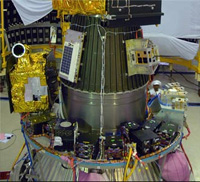
Rubin 8-AIS (Rubin payload at the left side
of the payload adaptor)
|
nanosatellites are NLS-5 AND RUBIN-8. NLS-4, developed by University of Toronto, Canada consists of six nano-satellites developed by various universities. Two of them - CUTE 1.7 and SEEDS - are built in Japan, while the other four - CAN-X2, AAUSAT-II, COMPASS-1 and DELPHI-C3 are built in Canada, Denmark, Germany and the Netherlands respectively. NLS-5 is also built by University of Toronto and RUBIN-8 is built by Cosmos International, Germany. The eight nanosatellite payloads of PSLV-C9 are built to develop nano technologies for use in satellites as well as for the development of technologies for satellite applications.
In its twelve consecutively successful flights so far, PSLV has repeatedly proved itself as a reliable and versatile workhorse launch vehicle. It has demonstrated multiple satellite launch capability having launched a total of sixteen satellites for international customers besides thirteen Indian payloads which are for remote sensing, amateur radio communications and Space capsule Recovery Experiment (SRE-1). PSLV was used to launch ISRO’s exclusive meteorological satellite, KALPANA-1, into a Geosynchronous Transfer Orbit (GTO) in September 2002 and thus proved its versatility. The same vehicle will be used to launch Chandrayaan-1 spacecraft, India’s first mission to Moon during this year.
I think it was Francis Bacon who once remarked: Money is like manure; it's not worth a thing unless it's spread around.” he added. Smt Shobhna Bhartiya, Chairperson, Hindustan times Ltd and representatives from leading luxury brands were also present on the occasion.Explaining about the contribution to luxury Industry from an Indian Perspective, Shri Kamal Nath informed that ‘Dharavi’, which is supposed to be Asia’s largest slum also doubles up as a giant manufacturing cluster.
Over the years, many migrants have moved there and have set up one-room factories, which have become extremely successful businesses. Migrants from Gujarat have established a potters' colony, and tanners from Tamil Nadu have migrated to Dharavi and set up a flourishing leather tanning industry. Other artisans, like the embroidery workers from Uttar Pradesh, started the ready-made garments trade.
The 15,000 odd one-room factories, at Dharavi manufacture products worth nearly 500 million dollars every year, a large proportion of which are exported. “My simple point of showcasing Dharavi is this: the skills of these artisans, and millions of others living in different pockets all over the country – can, and should be, effectively used by the global luxury players to develop their own low cost manufacturing bases. To be sure, quality could be an issue in the short term. But I am sure with the right environment and training, Indian artisans can work with European companies and develop world-class products for customers all over the world, he added.
As regards FDI in luxury sector, Shri Kamal Nath stated that India is keen to encourage the entry of foreign investment in the luxury sector to offer more choices to the Indian consumer. But the Government of India would like to facilitate this entry, at a pace that does not put local manufacturers and unorganized retailers at a risk |


