|
In my remarks this evening I will seek to outline the contours of India’s Foreign Policy. I will focus on the implications of globalization on India’s economic security and how we should posture ourselves in our way forward in tune with the emerging international order.
Foreign policy of a country is the pursuit of national interests, deriving essentially from its overall national policies, its future goals, and the self perception of its role and destiny in the world. India’s approach to the world is naturally a function of our values, civilisational heritage, historical experience, and geography. It is also of how we perceive our interests, based on principles and a broad national consensus.
India’s engagement with the world has been based on a desire to establish a peaceful, secure and equitable world order. The objectives of our foreign policy have been to sustain an international environment conducive to our growth and development, alleviate poverty, and foster equity and prosperity for our citizens. Peace and security in our neighborhood, and in the larger region, are a vital consideration in our strategies. Our commitment to disarmament, non-proliferation and responsible use of nuclear technology has underlined our role in international security. We have engaged with major powers on multiple issues and challenges. We have contributed to international peacekeeping efforts under the aegis of the UN, and remained active in combating terrorism. In the aftermath of natural disasters in Asia, India has been swift in its response, bringing succor to many.
Our policy of non-alignment is our ability to judge and to act on our own judgment on the basis of enlightened self-interest, so that we are not passive observers or recipients, but are contributing to shaping a global order. Our policy further seeks to nurture and increase our activism in traditional constituencies in the developing world.
We also strive for India to be a factor of stability and a voice of moderation in the world, whose progress is beneficial to the creation of an equitable, peaceful and stable world order. Our civilisational philosophy of Vasudhaiva Kutumabkam, perceiving the world as one large family, has shaped our approach as equitable rather than self-centred. Even as we draw from the world, we remain ready to contribute. We are now a net aid donor, extending a broad spectrum of technical cooperation to some 156 nations.
The Indian economy has been completely transformed from what it was in 1947, or even two decades ago. Since the economic reforms program initiated in the early 1990s to integrate India with the world economy, we have steadily moved ahead toward greater openness to trade and investment. Today the robust Indian economy is attracting widespread foreign investment and has emerged as an internationally competitive market economy. India’s share in the global flows of goods, services, knowledge and culture has grown significantly over the past decade. India’s contribution to the global economy continues to rise, aided by the ‘demographic dividend’, the intangible gains of the global knowledge economy, and the expansion of India’s soft power.
Our capabilities and new responsibilities have led India to rediscover its global role in international security. India's global engagement has increased dramatically in recent years. Our relations with all the major powers are being strengthened, as well as with emerging economies in Asia, Latin America and Africa. We are also investing energy in crafting bilateral and multilateral trade arrangements and measures to promote investment and technology flows.
One of our primary strategic challenges is to restore traditional linkages within our region and between the region and the rest of the world. Connectivity would enable India’s reintegration into the immediate and extended neighborhood, whether in Central Asia, South East Asia or West Asia. This has led us to pursue actively cooperative arrangements such as SAARC, BIMSTEC, our dialogue with ASEAN and in East Asia, the IBSA forum with Brazil and South Africa, RIC - the trilateral initiative with Russia and China, and the recent India-Africa Summit. In pursuance of a vision of prosperity, India’s political and economic ties with the Asia-Pacific region are also growing, and we are also developing closer linkages with major powers like the United States, Japan, the European Union and Russia. Today, India enjoys strategic partnerships of one kind or another with about a dozen countries - and the EU. We are also clear that the development of closer relations between India and any one strategic partner need not be at the expense of relations with any third country.
The Indian Ocean littoral today has greater economic and strategic value to the world economy than ever before. India has a natural and abiding stake in the safety and security of the sea-lanes of communication from the Malacca Straits to the Gulf. We have endeavoured to promote greater cooperation between Indian Ocean littoral states.To sustain growth and development, a peaceful and stable neighbourhood is conducive, and must be given priority and special attention. We do not believe in territorial expansion or in exporting ideology. We are convinced that a stable and peaceful neighbourhood is essential to India’s future.
Our objective is to promote inter-dependence, create stakes in each other’s stability, and develop cross border infrastructure and other links. As the largest economy in the region, India is ready to offer its market and resources as an engine for the region’s growth. Since the 14th SAARC Summit hosted in New Delhi last April, India has made every effort to strengthen SAARC, moving it from a declaratory to an implementation phase. Our commitments to establish the South Asian University, Model Community Development Initiative and Tele-Medicine Project are already on ground.
As we now see, the international landscape, too, is undergoing dramatic changes. The current world order is one of “general un-alignment”, a de-hyphenation of relationships, and re-engagement amongst several major powers in informal alliances to deal with issues on the basis of convergence of interests. No great power today pursues exclusive cooperation with others, or asks us to limit ties with others. Indeed increased cooperation with one power opens the doors further with others. For the first time in India’s independent history, we are now on an upward spiral of improving relations with all major powers.
India’s entrepreneurs and professionals have leveraged these changes to create wealth and employment on an unprecedented scale. The changed global landscape obviously requires the application of democratic principles to global governance and management of the global diversity as well. India is ready to assume still greater international responsibilities, starting with a reformed and revitalized UN Security Council, reflecting the present day realities. The transformation in our approach is not just in scope and content but in our attitudes too. Today Indian diplomacy approaches the world and the opportunities that await it with much greater confidence. We look forward to leveraging the external environment to achieve faster growth.
The world today is increasingly multivalent, marked by considerable political cooperation among major powers whose economies are becoming inextricably intertwined with each other. The current global economy is increasingly defined by freer and substantial movement of capital and by the technology revolution, in particular information technology. While capital is free to roam the world, other factors of production like labour and technology are not, and access to markets remains patchy.India’s development imperatives demand intensive economic engagement with the rest of the world. India needs huge resources to foster inclusive growth, both in terms of funds as well as in terms of natural resources, energy resources, technology, and knowledge. |
Infrastructure requirements alone are expected to cross $500 billion in the next five years, and sustaining a 8-10% growth necessitates capital for manufacturing, agriculture, and services sectors estimated at around $1.5 trillion.
Global trade has an undeniably important role in fighting the evil of poverty and fostering economic development around the world. It however continues to face considerable barriers and distortions, particularly in the agriculture sector and by way of denial of access for trained manpower from the developing to the developed economies. India remains fully committed to the multilateral trading system. We eagerly look forward to early and successful completion of the negotiations for the fulfilment of the mandate agreed at Doha, with the development dimension at its core.
Technology access is another economic objective that we are giving high priority. India has remained isolated from high-technology commerce due to its position on nuclear energy. We hope to resolve this soon and implement various agreements on civil nuclear cooperation. We will continue to build a broad national political consensus on this issue so as to realise early the promise inherent in the initiative.
We have also been looking at energy sources. To this end, we are engaging in oil diplomacy with countries such as Nigeria, Saudi Arabia, Russia, and Venezuela. Our oil and gas companies are exploring and bidding in regions around the world, investing large amounts in places like Sakhalin, Sudan, and Vietnam. India is conscious of the fact that energy consumption during the course of its march to development could place pressures on carbon emissions. We have voluntarily placed limits on our per capita emissions, but we have a long way to go before we reach those limits. Immediate and real effect must be given to commitments on international cooperation in fighting climate change, especially in the areas of adaptation, technology transfer, capacity building and the development of the carbon market. Trade advantages should not be sought through the instrumentality of environmental treaties.
However, the world today is unfortunately not only about expanding economic and technological horizons. There are dangers and pitfalls like growth of terrorism, extremism and intolerance; energy, food and water security; environmental degradation and climate change; proliferation of weapons of mass destruction and the risk of their falling into the hands of irresponsible actors. These are interlinked, cross-boundary issues, with complexities going well beyond traditional dimensions. These are not issues of the future but are already confronting us. They require global solutions, to ensure that the process, inevitable as it is, proceeds with minimum bumps and upheavals. This calls for further streamlining and revamping of global governance systems. Equally, the architecture of international financial structures, including that of the institutions such as World Bank and the IMF, needs urgent revamping to better serve the international community.
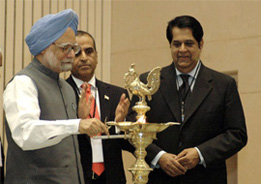
The Prime Minister, Dr. Manmohan Singh Lighting the Lamp to inaugurate the CII National Conference and Annual Session, 2008, “Building People: Building India” in New Delhi on April 29, 2008. |
The primary challenge for the world, and for India, still remains the elimination of poverty, and a radical improvement in the living standards of people in the developing world, as the minimal first step. Our approach for this remains rooted in widest consultation and cooperation, including South-South cooperation. Recent steep rise in food prices, in India and all around the world has brought the issue of food security starkly to the fore. Food security for us is not only about food production, given that 2/3rds of our population is dependent on agriculture. Last year India was a net importer of food after many years.
The growing size of our population, and economic growth and prosperity, have led to consumption and life-style changes. By 2020, we are estimated to require 340 million tonnes of food grains. This is a challenge for our scientists, planners and administrators. We need to tap into the resources of developed countries, to usher in our second Green Revolution, harnessing contemporary tools like bio-technology, water conservation and rain harvesting techniques and other steps which are environmental-friendly and economically sustainable. The SAARC Regional Food Bank and the India-US Agriculture Knowledge Initiative are steps in this direction, and we need to follow up with further similar arrangements.
Management of increasingly inadequate water resources for drinking, agriculture, industry, and power, is another critical challenge for the future. While our sub-continent is fortunate to have abundant water, we have not seen enough collaboration in its use. We have to address this, and, as agreed at the SAARC Summit, we will work with our neighbours in this regard.
In concluding, I should like to re-emphasise that the focus of our economic diplomacy in coming years will be on promoting trade and investment flows, especially in critical areas such as infrastructure, in assuring predictable energy supplies and in securing the widest possible access to technologies. We would work towards significantly upgrading our economic relationship with South-east Asia, East Asia, Latin America and Africa, and build new investment-driven partnerships with USA and EU. We intend to nurture a web of cooperative energy security networks in Asia and with new suppliers in West Africa, Central Asia and Latin America.
In today’s environment, business has taken centerstage in economic development, with governments building the right operating and investment climate for it. Under current conditions, it is crucial that industry and government come together to form holistic strategies for leveraging the forces of globalization for economic prosperity. Corporates through their overseas mergers and acquisitions, their international manufacturing and service operations, and their expansion of overseas markets have taken the lead role as effective partners in India’s global engagement.
Indian diplomacy would get more business oriented and the integration of science & technology and other knowledge-based initiatives into our foreign policy goals would be the norm. The challenges that India's foreign office faces today are different from those that we faced in the past, and the challenges of tomorrow will be different still. India's envoys abroad today represent a different India. It is an India that may not have yet solved all its problems, but is still resurgent and confident. It is an India that is no longer satisfied with being a spectator in any arena. It is an India willing to be heard with a voice that can make a difference to any outcome. And, as home to one sixth of the world's population, it is an India that has not only a vital stake in the future of the world - whether we view this future in political, economic or even environmental or energy terms - but also the wherewithal to play a decisive role in shaping this future.
The rapid expansion and qualitative change in India’s foreign policy perspectives that I have mentioned are in India’s interest and also a positive development for international peace and stability. In keeping abreast with the new global challenges - from trade to environment to international security - or in the new regional opportunities for peace and prosperity, India is ready to fulfil its obligations. India, with its unique blend of ‘hard’ and ‘soft’ power, would be an indispensable player in strengthening peace, stability and prosperity in its region and indeed in the world.
I look forward to your views and ideas on how to develop greater synergy between industry and government for commerce. I wish you all a very successful annual session and conference, marked by fruitful deliberations and conclusions. |


