
CARTOSAT-2A
|
In its thirteenth flight conducted from Satish Dhawan Space Centre (SDSC) SHAR, Sriharikota, on April 28, 2008, ISRO’s Polar Satellite Launch Vehicle, PSLV-C9, successfully launched the 690 kg Indian remote sensing satellite CARTOSAT-2A, the 83 kg Indian Mini Satellite (IMS-1) and eight nanosatellites for international customers into a 637 km polar Sun Synchronous Orbit (SSO). PSLV-C9 in its ‘core alone’ configuration launched ten satellites with a total weight of about 820kg.
After the final count down, PSLV-C9 lifted off from the second launch pad at SDSC SHAR, at 09:24 Hrs IST with the ignition of the core first stage. The important flight events included the separation of the first stage, ignition of the second stage, separation of the heatshield at about 125 km altitude after the vehicle had cleared the dense atmosphere, second stage separation, third stage ignition, third stage separation, fourth stage ignition and fourth stage cut-off.
The 690 kg main payload, CARTOSAT-2A, was the first satellite to be injected into orbit at 885 seconds after lift-off at an altitude of 637 km. About 45 seconds later, Indian Mini Satellite (IMS-1) was separated after which all the nano satellites were separated in sequence. The initial signals indicate normal health of the satellites.
About CARTOSAT-2A
CARTOSAT-2A is a state-of-the art remote sensing satellite with a spatial resolution of about one metre and swath of 9.6 km. The satellite carries a panchromatic camera (PAN) capable of taking black-and-white pictures in the visible region of electromagnetic spectrum. The highly agile CARTOSAT-2A is steerable along as well as across the direction of its movement to facilitate imaging of any area more frequently.
Soon after separation from PSLV fourth stage, the two solar panels of CARTOSAT-2A were automatically deployed. The satellite’s health is continuously monitored from the Spacecraft Control Centre at Bangalore with the help of ISTRAC network of stations at Bangalore, Lucknow, Mauritius, Bearslake in Russia, Biak in Indonesia and Svalbard in Norway. High-resolution data from CARTOSAT-2A will be invaluable in urban and rural development applications calling for large scale mapping.
About Indian Mini Satellite (IMS -1)
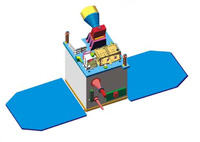
Indian Mini Sattelite - 1 (IMS-1)
|
Indian Mini Satellite (IMS-1), flown as an auxiliary payload on board PSLV-C9, is developed by ISRO for remote sensing applications. Weighing 83 Kg at lift-off, IMS-1 incorporates many new technologies and has miniaturised subsystems. IMS-1 carries two remote sensing payloads - A Multi-spectral camera (Mx Payload) and a Hyper-spectral camera (HySI Payload), operating in the visible and near infrared regions of the electromagnetic spectrum.
The spatial resolution of Mx camera is 37 metre with a swath of 151 km while that of HySI is about 506 metre with a swath of about 130 km. The data from this mission will be made available to interested space agencies and student community from developing countries to provide necessary impetus to capacity building in using satellite data. The versatile IMS-1 has been specifically developed to carry different payloads in future without significant changes in it and has a design life time of two years.
>> Continue on Page 02 |


