 |
|
Indo-Russian Jewellery Summit held in Mumbai
MORE
[+] |
 |
|
Gandhi Jayanti celebrated in Moscow
MORE
[+] |
|
| |
|
| |
'Private sector needs to push India-Russia economic relations'
The unique relationship between India and Russia has weak economic component because the relation is government-driven, a high-ranking Indian diplomat said.
"A government-driven relationship is not enough to boost economic relations and trade.. it needs the private sector to push the relationship," said Ajay Bisaria, joint secretary (Eurasia) in India's foreign ministry at a forum on India-Russia relations, jointly organised by the Federation of Indian Chambers of Commerce and Industry and the Ministry of External Affairs.
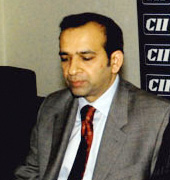
Mr. Ajay Bisaria, Joint Secretary (Eurasia Division), M.E.A
Admitting that the target of doubling bilateral trade by 2015 to $20 billion from its current levels of under $10 billion would be "challenging to meet", Bisaria mentioned some on-going initiatives for a qualitative change in the relationship.
"A Russia-India joint investment fund is being pushed by the government. Russia and China have a similar fund among themselves," Bisaria said. According to Bisaria, the government has been talking to the public sector State Bank of India for a $1 billion fund, but not enough private sector corporates have come forward to participate.
"A Comprehensive Economic Cooperation Agreement between India and Russia will be critical in this regard," Bisaria said. Such an agreement was discussed at the summit of both countries' leaders and there has been some progress, said Alexey Idamkin, political counsellor in the Russian Embassy here. "There has been some progress and a consensus reached on a mechanism - a Joint Study Group - towards preparing a comprehensive economic agreement," Idamkin said.
"India has taken the initiative to revive the International North South Transport Corridor project that involves countries like Russia and Iran. It is a purely economic project and politics don't enter here at all," Bisaria said. This transport corridor, passing thorugh Iran, among other countries, besides providing boost to economic activity in the region, would provide a time advantage of 40 percent over the Black Sea route to Europe.
Speakers at the forum pointed out how the Indo-Russian relationship has been unique and enduring on the basis of coinciding interests in political and strategic spheres.
India's former foreign secretary Kanwal Sibal pointed out that India had imported over $30 billion of defence equipment from Russia during 2001-2010.
In the context of the realisation about greater private sector involvement to carry forward the relationship, Bisaria drew attention to the sectors ripe for investment.
"There is a $18 billion pharmaceuticals and $16 million IT market in Russia for Indian investors to look at. Russia is also opening out a $33 billion privatisation opportunity. India is projected to invest $3 billion in infrastructure over the coming years... there is the planned Delhi-Mumbai industrial corridor. "There are huge opportunities coming up and the private sector needs to capture it," said Bisaria.
India seeks Russian investments
India sought Russian investments in the infrastructure sector particularly in the government's ambitious USD 100 billion Delhi-Mumbai Industrial Corridor (DMIC).
While speaking at the joint media interaction with Russian Deputy Prime Minister Dmitry Rogozin following India-Russia inter-governmental Commission meeting here, External Affairs Minister S M Krishna emphasised on increasing cooperation in IT and hydrocarbon sectors.
"Our growing economy and major initiatives in terms of the national manufacturing policy (NMP) and infrastructure development projects such as the DMIC offer good prospects for Russian investors and businesses," Krishna said.
The DMIC project, which was conceptualised in 2006, aims to create globally competitive environment and latest infrastructure to activate local commerce, enhance foreign investment, create employment opportunities, enhance exports and attain sustainable development. Under the project, world-class industrial enclaves will be developed along the Delhi-Mumbai rail corridor encompassing seven states - Delhi, Uttar Pradesh, Haryana, Rajasthan, Gujarat, Maharashtra and Madhya Pradesh.
Gazprom, India's GAIL agree 20-yr LNG sales deal
Russia's Gazprom Marketing and Trading has signed a legally binding agreement to supply liquefied natural gas (LNG) to India's GAIL for 20 years, the companies said on Monday. Under the terms of the agreement, GAIL will receive 2.5 million tonnes of LNG sourced from Gazprom's own production facilities and global trading portfolio, they said in a statement. The price GAIL pays the Russian gas giant will be based on an oil-indexed formula and the gas will be delivered to Indian LNG import terminals at Dahej, Dabhol and Kochi.
"We are looking forward to working together with GAIL to help meet India's expanding gas demand whilst securing a long-term market for Russian gas," Vitaly Vasiliev, CEO of Gazprom Marketing & Trading, said. Gazprom operates the Sakhalin-2 LNG plant, the only such enterprise in Russia, with annual production of 10 million tonnes. It plans to double LNG capacity by building another plant in the Pacific port of Vladivostok. GAIL is looking for additional LNG supplies to meet rapidly rising demand for fuel in one of the world's fastest growing energy markets and is also considering buying production assets."The deal with Gazprom reinforces GAIL's commitment to facilitate the development of the Indian market," GAIL chairman B. C. Tripathi said. "The deal also marks our efforts to create a well-diversified and secured supply portfolio."
RIL enters in a JV with Russia's petrochemical company SIBUR
Russia and Eastern Europe's largest petrochemical company SIBUR and India's largest private company Reliance Industries Limited (RIL) have agreed to form a joint venture named Reliance Sibur Elastomers Private Limited to produce 100,000 tonnes of butyl rubber per year in Jamnagar, India.
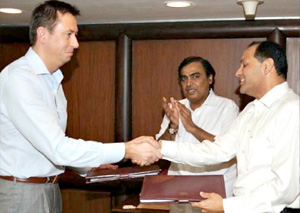 Dmitry Konov, President, SIBUR, Mukesh D. Ambani, CMD, Reliance Industries Ltd and Nikhil R. Meswani, Executive Director, Reliance Industries Ltd.
In an exclusive conversation with Sahara News Network, Evgeny Griva, CEO of SIBUR Petrochemical India has said that basic understanding for this JV was finalised during the visit of then Russian president Medeydev. The joint venture will be the first manufacturer of butyl rubber in India and the fourth largest supplier of butyl rubber in the world. At present India’s demand for butyl rubber is created mainly by the tyre industry and is fully supplied by imports from North America, Central Asia and European countries, including Russia.
Evgeny Griva also opined that SIBUR has the most eco-friendly technology for butyl rubber production which is being used only at SIBUR’s Tolyattikauchuk plant in Tolyatty (Russia). No other butyl rubber manufacturers in Russia, CIS or Europe use this technology. While in other petrochemical segments SIBUR do compete with global leaders, in butyl rubber segment they are a step ahead having a very advanced and unique technology. This technology was particularly interesting for Reliance and has formed the basis the joint venture.
The JV will meet demand for synthetic rubber from the Indian automotive industry, whose current requirement for more than 75,000 tonnes per year is satisfied by imports. Reliance Industries will own 74.9% of the JV with SIBUR 25.1%. The JV will plan to invest US$450 million to construct the production facility, which is expected to be commissioned in mid-2015, regarding official public data of both companies. SIBUR will develop basic engineering design for the facility and also train the JV’s personnel at its production site in Togliatti, Russia.
Girva is also hopeful that Siestema issue will not deter other Russian companies to invest in India. Since India-Russia relations is age old and there are lot of opportunities of investment in India and also the two countries benefit each other through transfer of technology especially in the field of petrochemicals.
|
|


