New financial order needed to prevent
future crises
By Ashok Handoo, New Delhi
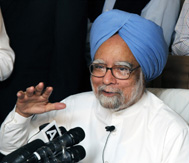
The Prime Minister, Dr. Manmohan Singh interacting the accompanying media on board flight to way back to Delhi, after attending the Summit on Financial Market and the World Economy, on November 15, 2008. |
The adverse impact of global financial crisis on developed as well as emerging economies the world over notwithstanding, India is confident that it will not only be able to withstand the challenge but will also come out stronger.
The Prime Minister Dr. Manmohan Singh in his inaugural address at the Leadership Summit in New Delhi, said “we have the ability to sustain a growth rate of about 8 percent. And we will do so” The confidence that India had the “resources and the wisdom to grapple and deal” with the crisis, is no less reassuring. He emphasized that all instruments of public policy – monetary, fiscal, public investment and the exchange rate will be deployed to tackle the crisis. Noting that the global economy was in “deep crisis” and passing through “choppy waters” Dr. Singh said “we can and we will survive this.” The Prime Minister’s words are quite significant in a situation when the country needs to boost consumer confidence by increasing consumer spending and improving job securities. This needs a concerted effort both within the country and at the international level.
The Finance Minister too, has made it clear at the Economic Editors’ Conference that there is no fear of recession hitting the country, as the growth rate for the first quarter of the current fiscal is 7.9 percent. The second quarter, he said, undoubtedly will show a positive growth. He urged the Media not to use the word recession with regard to Indian Economy. Admitting that we are passing through a difficult situation Shri Chidambaram said both the Government and the RBI will keep on responding to the situation suitably, as it has been so far. The Government, he said, is contemplating to increase expenditure in the infrastructure and the flagship programmes as a countercyclical measure to global slow down. There was enough indication that if the inflation rate continues to decline, policy rates may also moderate. The general outlook, however, continues to be of “cautious optimism”
The Planning Commission is of the view that “India could get away lightly due to its limited exposure in the international market”. In its recent analysis on the impact of global financial crisis on India, it said the growth rate of Indian Economy in the current financial year will continue to be one of the highest in the world. To add to this optimism, the Chairman of the Securities and Exchange Board Shri C.B.Bhave said that the Indian stocks would be the first to bounce back in the global meltdown and that there was nothing to worry about. He pointed out that “we have not found anything in the market that would suggest something had seriously gone wrong with the market itself.”
One important reason for India’s optimism is that the country’s financial system is well regulated. Fortunately, the Global crisis is receiving a global response. Leaders at the G-20 summit, which comprises both the developed as well as the emerging economies, held in Washington agreed to face the challenge together. The summit was emphatic that the problem did not develop overnight and it will therefore not be solved overnight, but with continued cooperation and determination it will be solved. It was also pointed out that the crisis offered a wide open window of opportunity for financial reforms.
But questions are being asked whether the crisis signaled failure of globalization. Some economists are worried about the impact of the financial crisis on poverty reduction if it spurts protectionism, undermining free trade policies. The Leaders were of the view that the answer is to fix the problem and move forward with the free market principles.
President Bush was emphatic that the answer did not lie in reinventing the system. The Asia-Pacific Economic Cooperation (APEC) members who met at the Peruvian capital, Lima, warned that the crisis should not be treated with protectionism. It is being emphasized that the global crisis needs a global response through better cooperation among the nations of the world.
But some European countries like France and Germany are in favour of greater intervention. They want to change the rules of the game in the financial world and have been expressing surprise over warnings against too much regulation of financial markets. There is no denying the fact that the world economic situation is grim and that the impact of the current crisis will be most severe on the poorest of the countries and the poorest populations of other countries.
The crisis has spared no one. India is facing a growth slow-down from 9.3 percent last year, to around 8 percent this year. China, one of the largest economies of the world, may see a growth fall from well over 11 percent last year to 9 percent this year. Other countries are faced with a similar situation. What is now needed is all possible measures to boost consumer demand. And that is what India and other countries are doing. Central banks world wide are cutting key interest rates with some even bringing it close to zero rate.
|
RBI opens doors to 10 VCFs amid liquidity crunch
Mumbai
The Reserve Bank of India, which has been holding back applications of several foreign venture capital funds (VCFs) for a few years, is slowly opening the doors to these investors - a decision which could be partly driven by the dollar shortage following the FII outflow. During the last fortnight, the central bank has cleared proposals of as many as 10 foreign VCFs which are adequately capitalised. Many VCFs were setting up entities in Mauritius with only a few thousand dollars as the overseas investors in the funds were reluctant to park the money in Mauritius before the regulatory clearance. This was unacceptable to RBI.
Indeed, RBI had returned more than 16 foreign VCF applications to Sebi citing 'under-capitalisation' as the reason. After this, several foreign VC funds began capitalising the investment company before approaching the financial sector regulators. Sources said Sebi has already issued the in-principle approval to 10 applicants. However, while clearing the cases, RBI has inserted a new clause, which restricts investments by these foreign funds to certain sectors, similar to those prescribed under the Income Tax Act for availing of a tax pass-through for Sebi-registered VCFs.
Under this, foreign VCFs will be permitted in 10 sectors like infrastructure, biotechnology, IT related to hardware and software development, nanotechnology, seed research and development, R&D of new chemical entities in pharma sector, dairy industry, poultry industry, production of bio-fuels and hotel-cum-convention centres with seating capacity of more than 3,000. Sources said the new guidelines will be applicable to only new applicants and will not impact the existing foreign private equity players. Also, foreign venture capital investors hereafter will be only allowed to invest in those domestic venture capital funds which have exposure to these 10 sectors. “While the idea in the current economic scenario would have been to attract more foreign capital, imposing such restrictions may significantly hamper the investment activities of these FVCIs,” said Vikram Shroff, senior associate (funds practice), Nishith Desai Associates.
These 10 foreign approved VCFs have committed about $4-5 billion to India, sources said. “By restricting investments by foreign VCFs into these specific sectors, RBI is trying to promote them. However, these sectors are of limited usage for us. Some sectors don't even appeal to us considering the returns they generate. We just hope that RBI would increase the sectors in this list,” said a senior executive of a US-based private equity fund who has received the approval,” said a source. Even at this point, close to 50 applications are still pending before RBI. Of these, nearly 20 applicants are funds keen on investing in real estate sector. At present, there are close to 100 registered foreign VCFs in the country. Most of these funds are based out of Mauritius due to the natural advantage that a double-taxation avoidance treaty offers.
|
|
FIPB nod for 30 FDI-boosting proposals
As many as 30 proposals involving foreign investment of over Rs 6,000 crore through holding companies have been cleared by the Foreign Investment Promotion Board (FIPB) in the past couple of months. The proposals involve conversion of an operating company into a operating-cum-holding company (OHC) to facilitate downstream investments. The move is significant since it could boost FDI inflows at a time FII money worth $12 billion has left the bourses. The clearance of such proposals increased at least 50% this year compared to last year.
The board is also providing clearances to companies that have made downstream investments without prior permission. Clearance with retrospective effect is being provided in such cases subject to compounding by RBI. Some holding company proposals approved by FIPB in the last two months cover projects such as Essar Global-Asia Motorworks, Adani Power, Mauritius-based private equity major TPG Holdings, Suzlon Energy and Krishnapatnam Ports.
FIPB last week cleared Asia Motorworks proposal for induction of foreign capital worth Rs 590 crore from Essar Global through formation of a holding-cum-operating company. The Indian company would now issue convertible debentures and preference shares to Essar Global worth Rs 590 crore. Similar approvals were given to TPG to make downstream investments worth Rs 800 crore through a holding company for carrying out investment operations in India. The board also approved Suzlon proposal to set up a holding company to make downstream investment in wind turbine energy systems. With FIIs pulling out, officials feel FDI is the only route for boosting capital flows. Hence, approvals are being put on fast track.
To expedite clearance of FDI proposals, the board is also rejecting objections of treaty shopping raised by the revenue department. Over-ruling objections from the department of revenue, the Essar Group's Cayman Island-based holding firm Essar Global received FIPB approval for its proposed investment in truck-making company, Asia Motorworks. In many other cases, the board has given clearances with the observation that the department could continue with investigations.
|
Import of Sensitive items during April-September 2008
The total import of sensitive items for the period April-September 08 has been Rs.20560.2 crore as compared to Rs.16216.6 crore during the corresponding period of last year thereby showing an increase of 26.8%. The gross import of all commodities during same period of current year was Rs.661208 crore as compared to Rs.456407 crore during the same period of last year. Thus import of sensitive items constitute 3.6% and 3.1% of the gross imports during last year and current year respectively.
Imports of milk & milk products and food grains have shown a decline at broad group level during the period. Imports of items viz. edible oil, automobiles, fruits & vegetables (including nuts), cotton & silk, products of SSI, rubber, spices, alcoholic beverages, marble & granite and tea & coffee have shown increase during the period under reference.
In the edible oil segment, the import has increased from Rs.6009.23 crore last year to Rs.6182.89 crore for the corresponding period of this year. The import of crude edible oil has gone down by 6.5% and that of refined gone up by 79.2%. The increase in edible oil import is mainly due to substantial increase in import of refined bleached deodorised palmolein. Imports of sensitive items from Indonesia, China PRP, Korea RP, Myanmar, Japan, Germany, United States of America, Malaysia, Cote D’ Ivoire, Thailand, Czech Republic, Italy, Benin, Australia, Egypt, Sweden, Guinea, United Kingdom etc. have gone up while those from Argentina, Canada and Brazil etc. have shown a decrease.
|
|